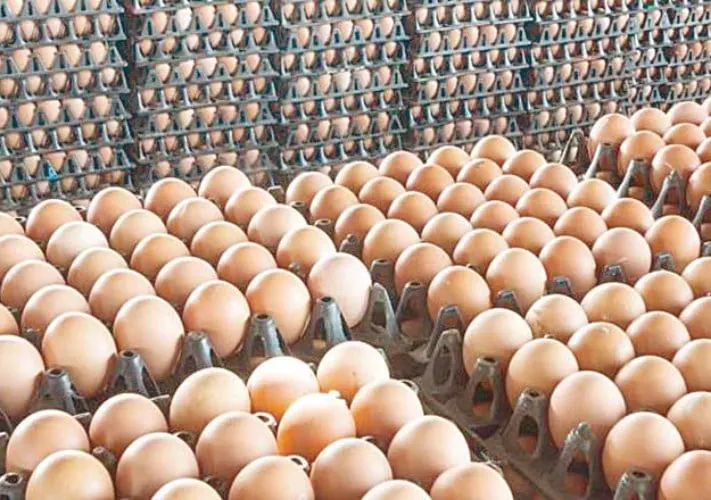
Egypt's egg prices have stabilized at 110-120 pounds per carton at farms, according to Abdelaziz El-Sayed, head of the poultry wealth committee at the Cairo Chamber of Commerce. The government is working to provide support to small and large producers, and to open new export markets in Arab and African countries, as well as international markets. This comes after Egypt was approved as one of the countries that apply the isolated poultry farm system in accordance with the regulations of the World Organisation for Animal Health (WOAH).
The Egyptian poultry sector has achieved an unprecedented investment and production boom in recent years, with investments exceeding 200 billion pounds, according to Dr. Tarek Soliman, head of the animal and poultry wealth development sector. The Ministry of Agriculture is working to provide easy financing to breeders in cooperation with the National Bank of Egypt and the Egyptian Agricultural Bank, to support the purchase of production requirements such as feed, chicks, medicines, and veterinary vaccines.
The price of eggs for consumers is 130 pounds per carton for white eggs, and production has increased to 16 billion eggs, compared to 14 billion eggs in the previous year. The production of local poultry has also increased to 360 million birds, an increase of more than 12%, according to Dr. Tarek Soliman, head of the animal and poultry wealth development sector. The sector is working to develop breeding and production systems to increase efficiency and economic returns.
The price of a carton of eggs ranges between 130-135 pounds, and the sector includes more than 27,000 diverse farms, including farms for producing table eggs, broiler chickens, and parent birds, as well as specialized companies for producing parent and grandparent birds, according to statements by Agriculture Minister Alaa Farouk.
The price of local eggs is 140 pounds per carton, and the state has succeeded in increasing the production capacity of veterinary vaccines to 2.3 billion doses annually, compared to 120 million doses annually previously, according to Agriculture Minister Alaa Farouk. The poultry industry is one of the pillars of food security and the national economy, providing direct and indirect job opportunities for about 3.5 million citizens.
The egg exchange today ranges from 130-135 pounds, and the Ministry of Agriculture is working to accelerate the opening of new markets to absorb the surplus of local production, in light of the boom in the poultry sector. The average share of an individual in Egypt of local farm eggs is about 140 eggs annually, according to statements by Agriculture Minister Alaa Farouk.
The price of red eggs is 135 pounds per carton. The government is working to support the poultry sector and increase its competitiveness in the global market. The sector has achieved significant growth in recent years, and the government is committed to continuing its support to ensure the stability and growth of the sector.
Key points
- Egypt's egg prices have stabilized at 110-120 pounds per carton at farms.
- The poultry sector has achieved an unprecedented investment and production boom in recent years, with investments exceeding 200 billion pounds.
- The government is working to open new export markets in Arab and African countries, as well as international markets.