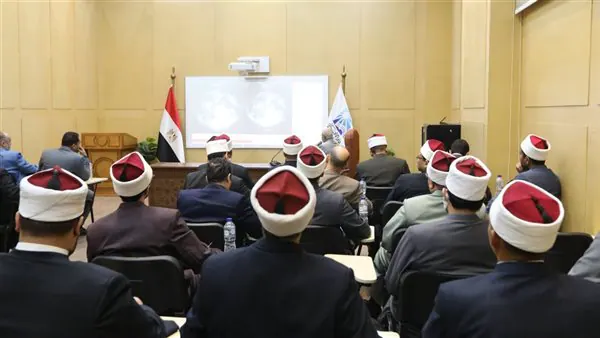
Dar Al-Ifta in Egypt has initiated a training program titled "Sharia Astronomy: Scientific Data and Sharia Controls." This program is a collaboration between Dar Al-Ifta's Training Center, Al-Azhar Global Center for Sharia Astronomy, and Al-Azhar University's Faculty of Sciences. The course features a selection of astronomy and Sharia specialists. The first day included three lectures on basic astronomical concepts related to calculating lunar phases and times, and controls for proving the beginning of Islamic months.
The first lecture, "Basic Astronomical Concepts for Sharia Calculation: Lunar Phases and Times," was presented by Dr. Ahmed Shukri Abu Al-Futuh from the National Institute for Astronomical and Geophysical Research. He emphasized that astronomy is not a source of Islamic law but a science that helps understand reality and control cosmic phenomena related to certain Sharia rulings. Dr. Abu Al-Futuh reviewed the historical development of "astronomy" in Islamic civilization and highlighted the importance of distinguishing between scientific study of celestial movements and "astrology," which is based on illusions.
Dr. Abu Al-Futuh discussed practical applications of astronomy in Sharia, including determining the direction of prayer, controlling prayer times, and navigation. He explained the difference between false dawn and true dawn, noting that the true dawn is a horizontal white spread in the horizon, which marks the beginning of Fajr prayer and fasting. Egypt uses a specific criterion to determine the true dawn, based on the sun's center being 19.5 degrees below the horizon.
The second lecture, "Scientific and Sharia Controls for Proving the Beginning of Months," was given by Dr. Abd al-Aziz Bakri Ahmad from Al-Azhar University's Faculty of Sciences. He discussed the astronomical properties of the moon's movement and the scientific standards for sighting the crescent moon. Dr. Bakri explained that the moon is an opaque body that reflects sunlight and moves in an elliptical orbit around Earth, causing its apparent size and distance to change.
Dr. Bakri highlighted the difference between the start of a lunar month in astronomical terms and the beginning of a Hijri month from a Sharia perspective. He noted that astronomical calculation is linked to the moment of central conjunction or new moon, while the start of a Hijri month is contingent upon sighting the crescent moon or its possibility after sunset, according to established controls. Dr. Bakri reviewed various criteria for estimating the possibility of sighting the crescent moon, from ancient to modern standards.
The third lecture, "Astronomical Observation and Technical Applications: Methodology of Crescent Sighting Committees and Documentation of Sighting," was presented by Dr. Abd Allah Ahmad from Al-Azhar University. He covered the scientific and practical foundations of astronomical observation, explaining basic concepts related to the celestial sphere, equator, and ecliptic. Dr. Ahmad demonstrated how to determine directions and identify the geographic north using the North Star.
Dr. Ahmad discussed the importance of the North Star in navigation due to its proximity to Earth's axis of rotation. He also addressed solar eclipses and their relation to conjunction, noting that a solar eclipse occurs when the moon passes between Earth and the sun under specific geometric conditions. The program aims to enhance scientific and applied knowledge of astronomical issues connected to Sharia rulings.
Key points
- The course features lectures on basic astronomical concepts for Sharia calculation, scientific and Sharia controls for proving the beginning of months, and astronomical observation and technical applications.