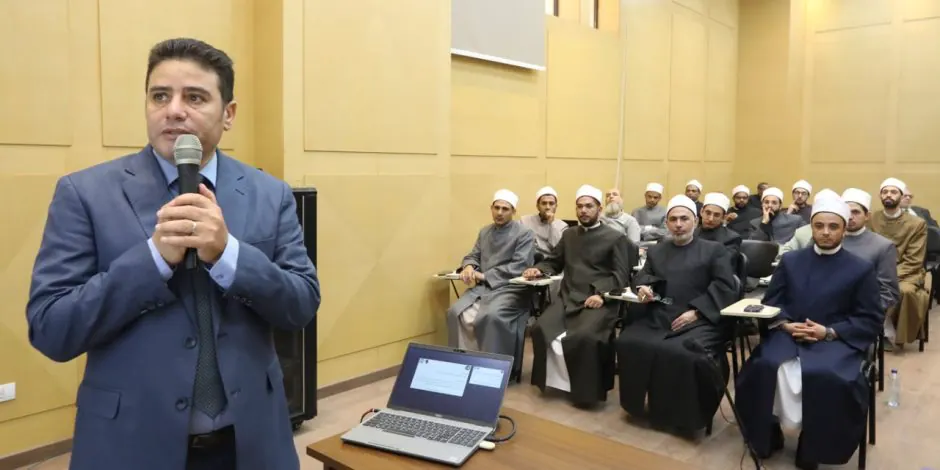
Egypt's Dar Al-Ifta, in collaboration with the Al-Azhar Global Center for Islamic Astronomy and Cairo's Al-Azhar University, has continued its two-day training program titled 'Islamic Astronomy: Scientific Data and Legal Controls.' The program features three specialized lectures on the astronomical foundations for calculating prayer times, methods for determining the Qibla direction, and regulations for prayer and fasting in high-latitude areas. These lectures were presented by prominent professors from Al-Azhar University's astronomy and meteorology department.
Dr. Kamil Jadd Allah, head of the astronomy and meteorology department at Al-Azhar University, explained that the movement of celestial bodies follows precise laws and calculations. He emphasized that the apparent movement of the sun is directly linked to the prayer times for the five daily prayers worldwide. Dr. Jadd Allah reviewed the astronomical foundations used to calculate sunrise, sunset, noon, afternoon, dawn, and evening, highlighting the differences between various systems used in several Islamic countries.
Dr. Jadd Allah discussed the astronomical controls related to calculating twilight and the degrees of solar depression below the horizon, noting that twilight duration varies with seasons and latitude. This makes relying on a fixed time for evening prayer inaccurate from an astronomical perspective. He warned against using sunrise and sunset directions to determine the Qibla due to the impact of Earth's axial tilt and the sun's changing position throughout the year.
Dr. Muhammad Bahyri, a professor in Al-Azhar University's astronomy department, presented the astronomical rules for determining the Qibla direction. He stressed that flat maps can lead to errors in determining directions due to distortions in distances and angles resulting from projecting the Earth's sphere onto a flat surface. Dr. Bahyri reviewed the two primary methods for determining the Qibla: the computational method based on spherical triangle laws and the direct solar alignment with the Kaaba.
Dr. Bahyri explained the types of civil, marine, and astronomical twilight and differentiated between true dawn and false dawn. He called for enhanced studies and joint field observations between Islamic scholars and astronomers to achieve greater accuracy in determining prayer times. The lectures also touched on the challenges of calculating prayer times and fasting regulations in high-latitude areas.
Dr. Abdulrazak Shaltut, an astronomy professor at Al-Azhar University, concluded the second day's lectures with a discussion on 'Prayer and Fasting in High-Latitude Countries.' He reviewed the astronomical and legal regulations related to prayer and fasting in these regions, explaining the scientific basis for calculating time differences and solar movement-related times. Dr. Shaltut addressed the issue of disappearing or disturbed astronomical signs in certain areas, classifying geographical regions based on the appearance of these signs.
Dr. Shaltut emphasized that Islamic law considers the circumstances of Muslims in areas where determining prayer times is challenging. He noted that estimation based on the nearest regions with regular astronomical signs or measurement using standard times in temperate zones is a legally accepted solution to alleviate hardship and achieve the objectives of Islamic law. The course aims to enhance understanding and application of Islamic astronomy in various contexts.
Key points
- Dar Al-Ifta continues its specialized training course on Islamic astronomy.
- The course discusses prayer timings, Qibla direction, and worship regulations in high-latitude areas.
- The program features lectures by prominent professors from Al-Azhar University's astronomy and meteorology department.