Egyptian President Abdel Fattah Al-Sisi arrived in Moscow on Wednesday to lead his country's delegation at the third Russia-Africa Summit. The summit, which runs through October 29, opened with the Economic and Humanitarian Forum. Al-Sisi is scheduled to hold bilateral talks with Russian President Vladimir Putin and deliver Egypt's address during the summit's plenary session on Thursday morning. This marks Al-Sisi's third participation in the gathering, having co-chaired the inaugural 2019 summit in Sochi and attended the 2023 summit in St. Petersburg.
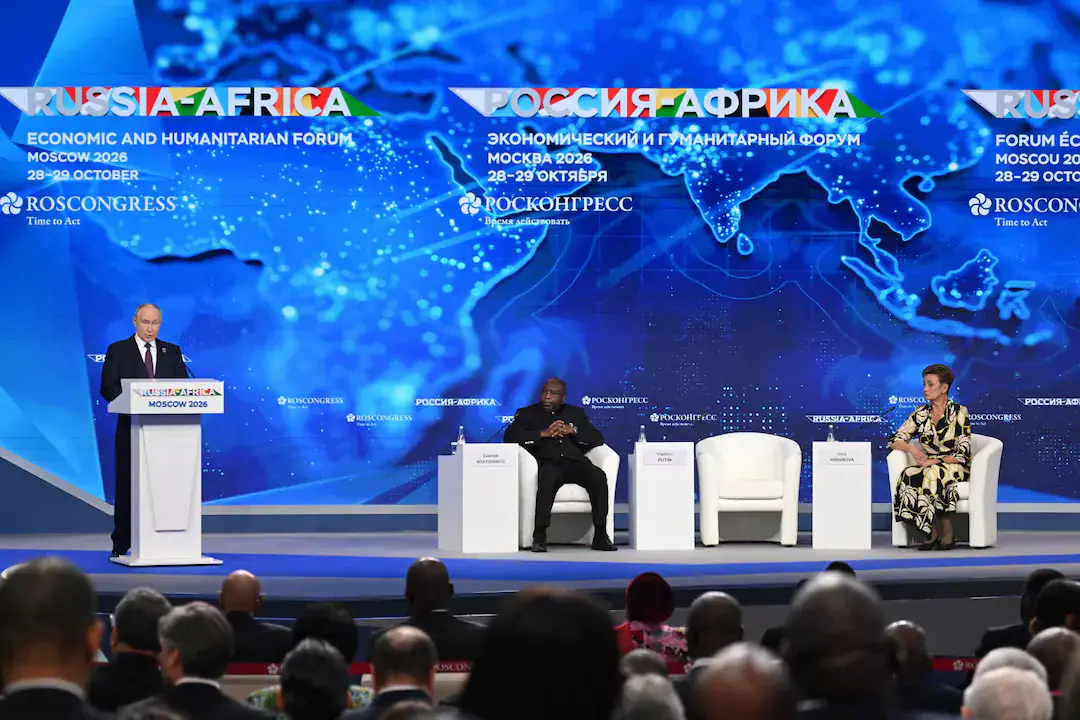
During the forum, Putin outlined plans to expand economic, technological, and agricultural ties with Africa while bypassing Western financial systems. He stated that Moscow aims to double Russia's trade turnover with the continent to surpass $50 bn in the near future. Russian-African trade turnover exceeded $27 bn last year, up from $18 bn in 2022. Putin highlighted Russia's role in food security, noting that Moscow exported 13 m tonnes of agricultural products to Africa in the first nine months of 2026.
Putin proposed developing alternative payment mechanisms using national currencies and existing pan-African payment systems to reduce reliance on Western financial networks. Moscow also offered to share digital technologies, including artificial intelligence models and cybersecurity platforms, alongside water management expertise. The Russian president referenced the 55th anniversary of Egypt's Aswan High Dam as a historical symbol of successful high-tech cooperation between Russia and the continent.
Beyond trade, Putin announced the extension of a sanitary and epidemiological assistance programme to 2029, which has already provided 15 mobile laboratories to eight African nations and trained 450 specialists. In the education sector, Russia has increased its scholarship quota to 5,500 for the 2026–2027 academic year, with a programme to compensate students for flights and accommodation. Around 40,000 African students are currently studying at Russian universities.
Speaking on behalf of the African Union, Burundi President Evariste Ndayishimiye welcomed the cooperation but demanded a balanced partnership. He stressed that Africa must no longer serve solely as an exporter of raw materials and urged Russian companies to invest directly in local processing, technology transfer, and infrastructure to create domestic added value and jobs.
Summit leaders are expected to adopt a Russia-Africa partnership action plan for 2027–2029 on Thursday to establish the framework for future cooperation. The plan aims to solidify the growing ties between Russia and Africa, with a focus on economic, humanitarian, and educational cooperation. Al-Sisi's participation in the summit underscores Egypt's commitment to strengthening its relationships with African nations and Russia.
The Russia-Africa Summit has become a significant platform for dialogue and cooperation between Russia and African nations. With Putin's ambitious plans to increase trade and investment, the summit is expected to yield concrete outcomes that will shape the future of Russia-Africa relations. Key points include:
Key points
- Putin aims to double Russia's trade turnover with Africa to $50 bn.
- Russia has increased its scholarship quota to 5,500 for African students.
- The summit will adopt a Russia-Africa partnership action plan for 2027–2029.