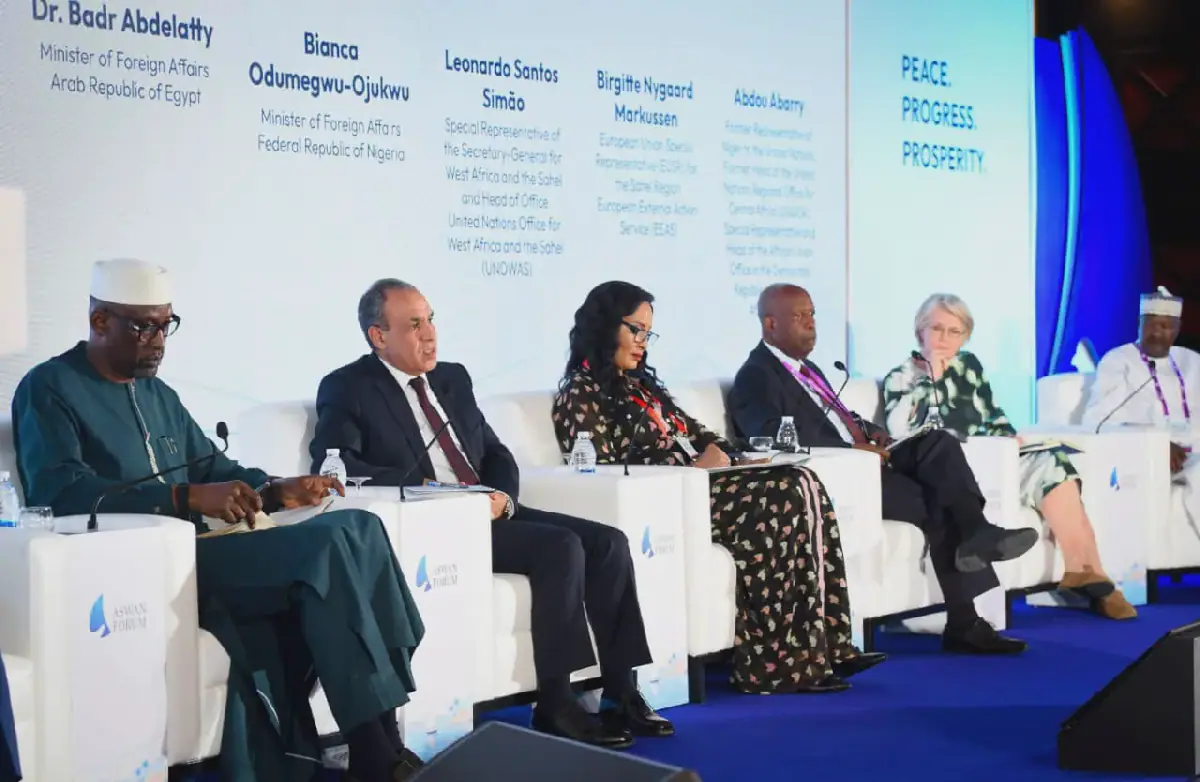
Egyptian Foreign Minister Badr Abdelatty participated in the Aswan Forum for Sustainable Peace and Development, discussing counterterrorism in the Sahel, Middle East security, and relations with Nigeria and Mali. He emphasized that lasting stability requires an integrated approach combining security, ideological, and development measures. Abdelatty highlighted the importance of addressing the underlying causes of terrorism and instability. The forum focused on security and development challenges in Africa and the Middle East amid mounting geopolitical and economic pressures.
Abdelatty stressed that development offers the most sustainable foundation for security by transforming natural resources into economic opportunities, creating jobs, and improving living standards. He called for stronger African institutional frameworks and a greater role for the African Union and mechanisms under the Community of Sahel-Saharan States. The Cairo-based counterterrorism centre of the Community of Sahel-Saharan States was highlighted as a mechanism for regional coordination, capacity building, and information exchange.
Abdelatty reviewed Egypt's cooperation with Sahel countries in security, counterterrorism, and capacity building. He cited Al-Azhar's efforts to counter extremist ideology, training programmes run by the Egyptian Agency of Partnership for Development, and Egyptian companies' involvement in energy, infrastructure, and development projects. Egypt seeks to expand partnerships with Sahel states by combining security cooperation with investment, economic integration, and sustainable development.
In a separate discussion, Abdelatty outlined four principles underpinning Egypt's approach to regional peace. The first involves moving from ceasefires to clear political processes addressing conflict root causes. He called for the full implementation of the second phase of US President Donald Trump's peace plan, including Israeli forces' withdrawal, enabling a national committee to administer Gaza, and establishing an independent Palestinian state.
Abdelatty's second principle involves supporting national state institutions, sovereignty, and territorial integrity. He called for supporting Lebanese state institutions, preserving Syria's unity and sovereignty, achieving a comprehensive political settlement in Yemen, and maintaining de-escalation and dialogue in addressing tensions involving Iran. Egypt views its security as closely linked to that of Gulf states and the wider region.
On the sidelines of the forum, Abdelatty chaired a meeting of the advisory council of the Cairo International Center for Conflict Resolution, Peacekeeping and Peacebuilding. A joint international advisory council for the Cairo Center and the Aswan Forum was launched, with former Egyptian Foreign Minister Amr Moussa named honorary chairman. Abdelatty met with Nigerian Foreign Minister Bianca Ojukwu to discuss trade, investment, agriculture, and capacity building.
Abdelatty also met with Malian Foreign Minister Abdoulaye Diop, calling for convening the two countries' joint committee and increasing trade and investment. He reiterated Egypt's support for counterterrorism efforts in the Sahel and called for continued cooperation through security, ideological, and development measures. The meetings aimed to strengthen coordination and translate forum discussions into practical initiatives in peace, security, and development.
Key points
- Egypt's Foreign Minister outlines integrated approach to security in Sahel and Middle East
- Abdelatty emphasizes development as foundation for security
- Egypt seeks stronger African institutional frameworks to combat terrorism
Reporting sources
- Abdelatty outlines Egypt’s approach to security in Sahel, Middle East · Daily News Egypt