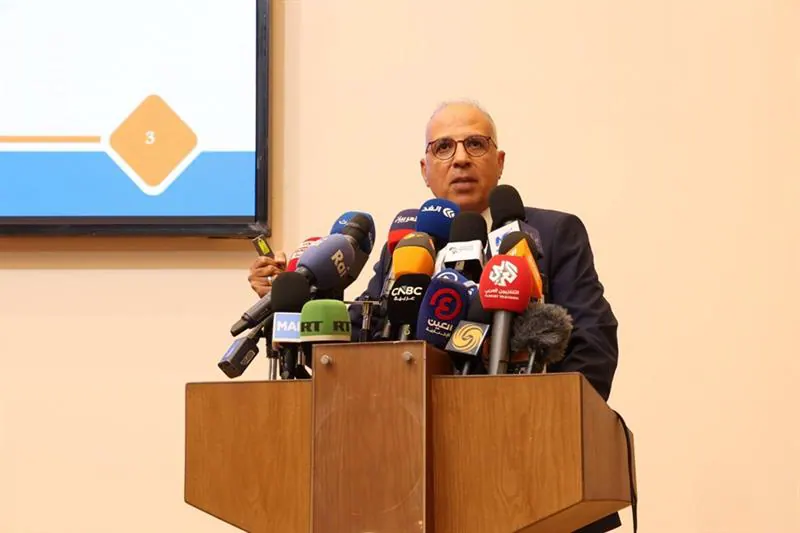
Egypt's Irrigation Minister Hani Sewilam stated on Sunday that Egypt will not accept another fait accompli on the Eastern Nile and retains all options available under international law to protect its Nile water security. Sewilam described water security as an “existential issue” for Egypt, accusing Ethiopia of seeking unilateral control over the Blue Nile through the construction and operation of the Grand Ethiopian Renaissance Dam (GERD). He emphasized that Egypt is a strong state of peace that upholds international law and knows when and how to respond appropriately to protect its interests.
Sewilam's remarks followed statements by Ethiopian officials asserting Addis Ababa's right to continue building additional dams on the Nile without seeking permission from other countries. He said such language contradicted Ethiopia's longstanding presentation of the GERD as an electricity-generation project and revealed an attempt to establish unilateral control over a transboundary water resource. Egypt will neither disregard its vital interests in the Nile nor accept “illusions of controlling” water flows to the two downstream countries, Egypt and Sudan, Sewilam said.
The minister addressed more than 80 correspondents representing around 45 regional and international media organizations at a briefing in Cairo organized by the State Information Service (SIS). SIS Chairman Alaa Youssef attended the session. Sewilam described the GERD as a “unilateral and unlawful dam,” saying this was a deliberate political characterization based on Cairo's legal position on how it was built, filled, and operated.
Egyptian officials have recently warned that any additional Ethiopian dams built without consultation could pose an existential threat to the country's water security. Sewilam said the GERD's unilateral and uncoordinated operation had demonstrated its capacity to cause sudden increases in water discharges, which he termed an “artificial flood,” or sharp reductions that could create an “artificial drought.” Such fluctuations could disrupt dams and other water infrastructure in Egypt and Sudan, he said.
Cairo has repeatedly warned that the absence of operational data leaves downstream operators unable to anticipate changes in Blue Nile flows. In July, an Egyptian irrigation official said six turbines were operating at the GERD, placing the facility at no more than half its maximum power-generation capacity. Egypt also warned in November 2025 that irregular Blue Nile releases had caused sharp fluctuations in water flows, prompting it to use the Toshka spillway to absorb unexpected surges.
Sewilam said more than 98 percent of Egypt's renewable water resources originate outside its borders. The country has only around 56.8 billion cubic metres of renewable water resources annually, compared with estimated needs of about 123 billion cubic metres. Egypt's annual per capita share of renewable water has fallen to around 472 cubic metres, placing the country below the absolute water-scarcity threshold of 500 cubic metres per person.
Sewilam argued that Egypt's support for development in Nile Basin countries is a practical position, not a political slogan. Egypt has helped drill around 365 wells and establish solar-powered groundwater stations, rainwater-harvesting reservoirs, river berths, flood-forecasting centres. He sought to reassure Egyptians that the government continuously monitors the water situation and maintains strategic reserves and systems to forecast and manage different scenarios.
Key points
- Egypt retains all lawful options under international law to protect its Nile water security.
- The Grand Ethiopian Renaissance Dam (GERD) is a “unilateral and unlawful dam” that poses an existential threat to Egypt's water security.
- Egypt's annual per capita share of renewable water has fallen to around 472 cubic metres, placing the country below the absolute water-scarcity threshold of 500 cubic metres per person.