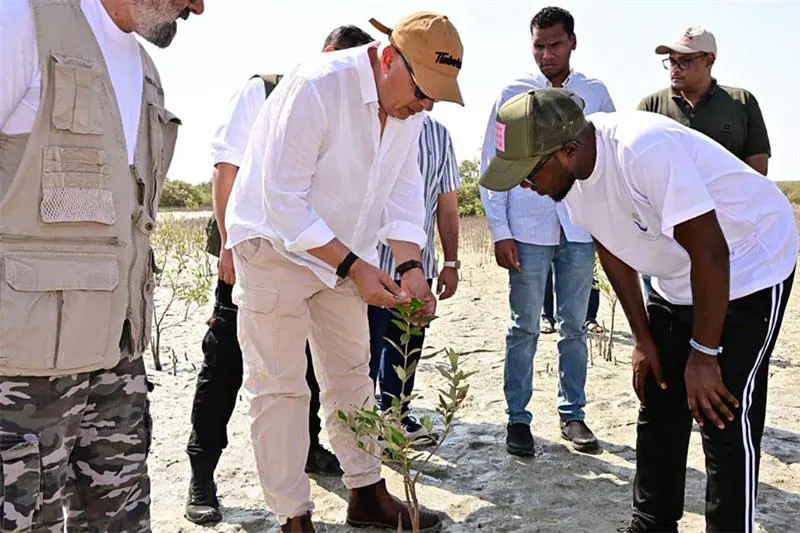
Egypt's Minister of Water Resources and Irrigation, Hani Sewilam, has completed a tour of Red Sea mangrove sites in Hamata, marking the end of a 50,000-tree planting drive. The project, "Developing a Participatory Model for Restoring Mangrove Ecosystems as a Nature-Based Solution to Climate Change," aims to restore mangrove cover and build related economic activities with local communities. Sewilam inspected mangrove cultivation areas inside the Wadi El-Gemal Nature Reserve, taking part in the final stages of planting.
The American University in Cairo is implementing the project with several partners to restore mangrove cover and build related economic activities with local communities in Hamata and Safaga. Each tree is expected to absorb between 350 and 400 kilogrammes of carbon dioxide over its lifetime, according to the ministry. The project also includes a women-led honey and beekeeping initiative that ties conservation to income for coastal communities in the Red Sea governorate.
Sewilam directed the Shore Protection Authority to study expanding mangrove planting in parts of the Red Sea as an alternative to conventional coastal defences. He emphasized that priority should go to nature-based solutions, with each site's characteristics determining the appropriate protection method. This directive builds on Egypt's wider efforts to designate sensitive coastlines as protected marine areas, including the Great Fringing Reef off the Red Sea coast.
During his tour, Sewilam met local volunteers and community representatives, discussing ongoing ecosystem-restoration efforts and ways to sustain them. He also visited the Hamata mangrove camp in the Al-Radda environmental area to review on-the-ground restoration work. The visit included a tour of the women-led mangrove honey and beekeeping project, which generates income for local communities and links ecosystem preservation to economic and social benefits.
Sewilam called for marketing the project's products to hotels and resorts in the surrounding area, tapping into the kind of mangrove ecotourism revenue that has grown along the Red Sea coast. He also reviewed the work of volunteers involved in participatory science, including planting seedlings, collecting and documenting field-monitoring data through photographs, and feeding the information into geographic information systems that support long-term monitoring of the Hamata mangrove ecosystem.
The effort forms part of a broader mangrove restoration project led by researchers and community groups along Egypt's Red Sea coast. Egypt's water resources ministry is pushing to expand nature-based approaches across its coastal and water-management programmes. Sewilam has warned that Egypt's per capita water share has fallen to around 490 cubic metres a year, well below international scarcity thresholds, citing rapid population growth and limited Nile resources as the country's main water challenges.
Mangroves are considered a vital ecosystem for storing carbon and protecting coastlines, in addition to providing habitats for fish and supporting biodiversity, according to the ministry. Sewilam also updated lawmakers on Nile inflows in recent months, saying in August that this year's Nile flood season recorded slightly below-average water levels. However, it was too early to determine whether Egypt was facing a drought year.
Key points
- Egypt's Minister of Water Resources and Irrigation orders study on mangrove-based coastal protection.
- 50,000 mangrove trees planted on Red Sea coast as part of climate change project.
- Egypt aims to expand nature-based approaches across coastal and water-management programmes.