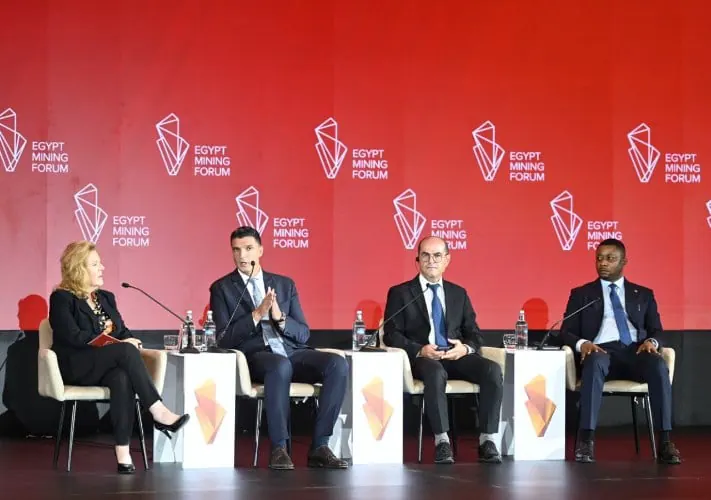
Egyptian Minister of Industry, Khaled Hashem, recently participated in a discussion session at the 5th Egypt Mining Forum. The session, titled "Aligning Mineral Resource Development with Industrial Growth," brought together ministers and officials from Egypt, Tunisia, and the Democratic Republic of Congo. Hashem highlighted Egypt's efforts to revitalize its mining and mineral industries as part of the country's industrial strategy. The strategy identifies basic minerals as key strategic industries.
Minister Hashem noted that Egypt is currently studying all minerals extracted in the country to assess their potential for manufacturing and to improve value chains. This aims to increase the value-added benefits of Egyptian minerals and transform them into raw materials that support the industry sector. The government is working to develop integrated value chains for the mining sector. This involves linking extraction, processing, refining, and mineral-based manufacturing.
The Egyptian government aims to utilize mineral resources to support higher-value industries, enhance local and regional supply chains, and reduce reliance on imported inputs. By doing so, the government hopes to create new export opportunities. Hashem emphasized that the goal is to treat mineral resources not as basic commodities but as raw materials for integrated industries. This will help link Egyptian industry with regional and global value chains.
Egypt has taken steps to limit the export of raw phosphate, prioritizing local manufacturing and higher-value industries such as the production of phosphoric acid and phosphate fertilizers. Minister Hashem pointed out that Egyptian manganese ore is a crucial input for the iron and steel industries, as well as heavy industries. It plays a significant role in maximizing the benefits of mineral resources and reducing imports of refractory materials and silicon-manganese alloys.
This year, Egypt collaborated with two companies to work on local processing of manganese ore. The goal is to provide high-concentration ore, boost exports, create new job opportunities, and deepen local supply chains. Hashem also highlighted the potential for cooperation among African countries in the mining sector. He noted that intra-African trade stands at around $220 billion, a relatively modest figure given the continent's 54 countries and vast resources.
Minister Hashem stressed the need for African countries to achieve integration in the mining sector. Each country can contribute its strengths, whether in training labor, providing expertise and skills, technology, mineral resources, or manufacturing capacities. The goal is to produce mineral-based products that serve all African countries. Egypt is set to host the "Africa El Alamein" forum next month, which will focus on these issues.
The integration of mining and industry is expected to have a positive impact on Egypt's economy. By maximizing the value-added benefits of its mineral resources, Egypt can create new opportunities for growth and development. The country's efforts to revitalize its mining and mineral industries are part of a broader strategy to boost economic growth and industrial development.
Key points
- Egypt aims to link its mining sector with industry to maximize value-added benefits from its mineral resources.
- The country has taken steps to limit the export of raw phosphate and prioritize local manufacturing and higher-value industries.
- Egypt is working to develop integrated value chains for the mining sector, involving extraction, processing, refining, and mineral-based manufacturing.