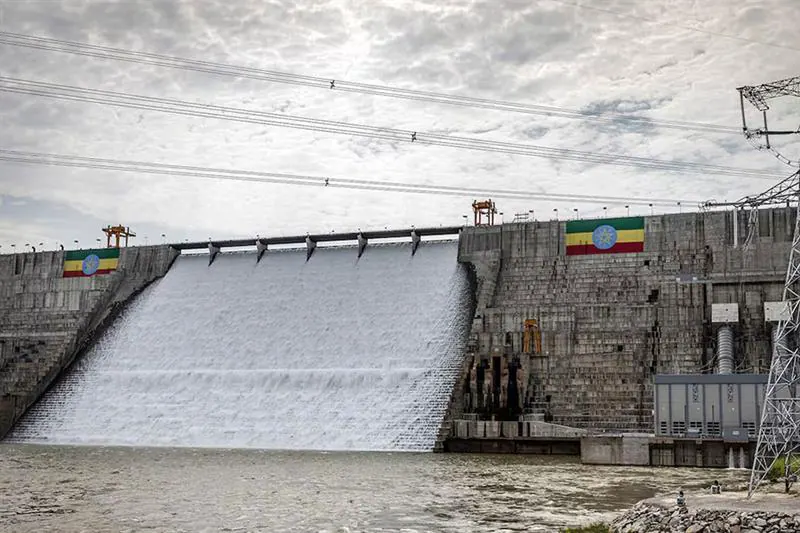
The Grand Ethiopian Renaissance Dam (GERD) is currently operating at half of its maximum power generation capacity, with only six of its 13 turbines functioning. According to Sameh Abdel-Rahman, deputy head of the Nile Water Sector at the Ministry of Water Resources and Irrigation, Egypt is closely monitoring developments at the dam, including water discharges and turbine operations, using satellite imagery and other methods.
Abdel-Rahman expressed concerns over Ethiopia's "mismanagement" in operating the dam, emphasizing that the dispute can only be resolved through a "legally binding agreement." He assured that Egypt's water needs are secure, thanks to the High Dam, which can meet the country's requirements even under severe water conditions.
Egypt is taking proactive measures to prepare for potential worst-case scenarios, including expanding the Toshka Spillway and increasing the capacity of its depressions to accommodate excess water. This project aims to increase the volume of water that can be discharged daily into the depressions, enhancing the country's ability to manage floodwaters.
Abdel-Rahman noted that it is too early to assess this year's Nile flood, citing previous seasons that began weakly before rainfall increased sharply in August and September. He also pointed to conflicting forecasts from international meteorological centers, including the US National Oceanic and Atmospheric Administration (NOAA), which presented contradictory projections.
The irrigation ministry reported that Nile inflows exceeded average levels in June before falling below average in July. A clearer assessment of the flood situation is expected after the first 10 days of August, when more hydrological and climatic data become available. Around half of the Blue Nile's July inflow typically arrives during the last 10 days of the month.
Experts attributed the decline in Nile flows to delayed rainfall, weaker seasonal flows, irrigation withdrawals, and GERD operations. However, they cautioned that the drop does not yet indicate an overall drought. Egypt depends on the Nile for over 90% of its freshwater, with the Blue Nile supplying about 85% of the 55 billion cubic meters of Nile water it receives annually.
Egypt's water stress is a pressing concern, with its annual per capita water share falling from around 2,000 cubic meters in 1960 to less than 500 cubic meters, well below the international water-poverty threshold of 1,000 cubic meters. The country's annual water demand has reached 88.55 billion cubic meters, compared with renewable resources of only 65.35 billion cubic meters.
Key points
- Egypt closely monitoring GERD operations and Nile flood situation
- GERD operating at half of its maximum power generation capacity
- Egypt taking proactive measures to prepare for potential worst-case scenarios