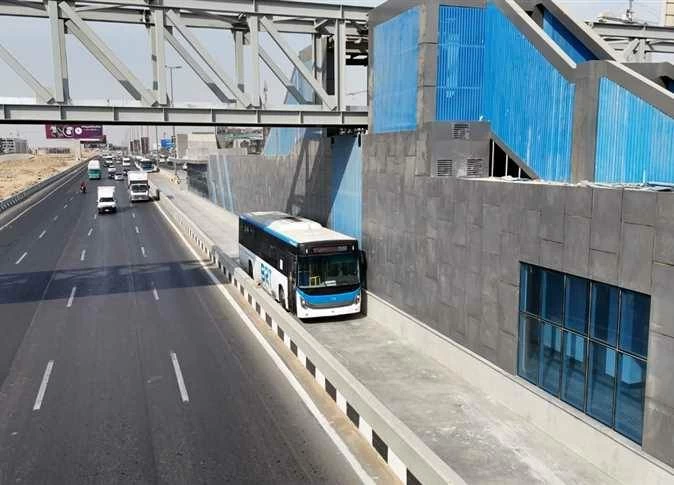
The Egyptian Ministry of Transportation has launched the second phase of its Bus Rapid Transit (BRT) system, a key part of the country's efforts to modernize its public transportation network. The new phase extends the service from the intersection of the Cairo Ring Road and the Alexandria Agricultural Road to the Sun Capital area. This expansion aims to improve connectivity between eastern, southern, and western Cairo.
The second phase of the BRT system includes 16 new stations, bringing the total number of stations to 30. Two of these stations, those at Marshal Tantawi and Golf, are already operational. The new stations include those at Ain El Sokhna Road, Maadi, and Merghany. The Sun Capital station, one of the main stations in the project, was built on an 80,000 square meter site at the intersection of the Cairo Ring Road and the Fayoum Road.
The Sun Capital station is designed as an integrated transportation hub, offering a range of services to passengers. It features a dedicated area for charging and maintaining the electric buses used in the BRT system, as well as a building for servicing passengers and companies affiliated with the Holding Company for Maritime and Land Transport. The station will also serve as a terminal for inter-provincial microbuses and provide parking for private cars.
According to Transport Minister Kamal El-Wazir, the launch of the second phase builds on the success of the first phase, which has seen significant uptake from the public. The minister noted that the dedicated lane for BRT buses on the Cairo Ring Road helps to reduce congestion and improve the efficiency of the service. He emphasized that the project is part of the ministry's strategy to expand modern public transportation and reduce reliance on private cars.
The BRT system is based on environmentally friendly electric buses manufactured locally, supporting efforts to promote sustainable transportation and deepen local manufacturing in the sector. The system is designed to integrate with other forms of public transportation, including the Cairo Metro, electric train, and monorail. This integration aims to provide seamless travel options for passengers and improve overall transportation efficiency in Cairo.
The expansion of the BRT system is expected to have a positive impact on traffic flow and air quality in Cairo. By providing a reliable and efficient public transportation option, the government hopes to reduce congestion and emissions in the city. The BRT system will also help to connect residents to key areas, including the New Administrative Capital.
The fares for the BRT service range from 5 to 35 Egyptian pounds, depending on the number of stations traveled. The service currently operates on 30 routes, with plans for further expansion in the future. The Ministry of Transportation is committed to continuing to develop and improve the public transportation network in Egypt, with a focus on sustainability and efficiency.
Key points
- The second phase of Egypt's BRT system has been launched, expanding the network to connect more areas in Cairo.
- The new phase includes 16 stations, bringing the total number of stations to 30.
- The BRT system is based on environmentally friendly electric buses manufactured locally.