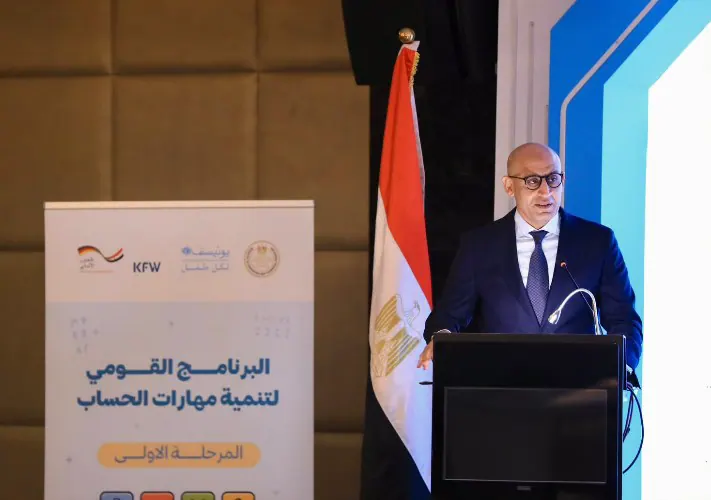
The Egyptian Ministry of Education and Technical Education, in partnership with UNICEF and Sawiris Foundation, has announced the launch of the fourth phase of the National Program to Develop Arabic Language Skills and the first phase of the National Program to Develop Math Skills. This initiative aims to enhance basic skills among children and support their ability to learn continuously. The announcement was made during a large-scale event attended by representatives from the United Nations, the World Bank, the German Development Cooperation Agency (GIZ), UNESCO, and the Japanese International Cooperation Agency (JICA).
The fourth phase of the Arabic language skills program will expand to three new governorates: Sohag, Asyut, and Fayoum. Meanwhile, the first phase of the math skills program will be launched in 10 governorates: Fayoum, Aswan, Asyut, North Sinai, Alexandria, Giza, Cairo, Damietta, Sohag, and Ismailia. Egyptian Education Minister Mohamed Abdellatif emphasized that being in school does not guarantee learning, and the education system's responsibility begins with ensuring that children acquire knowledge and skills within the classroom.
Minister Abdellatif highlighted that mastering reading goes beyond the subject matter, as it enables children to access knowledge independently, understand, ask questions, and explore new areas. He also noted that math is not limited to numerical operations but also develops logical thinking, pattern recognition, information analysis, and problem-solving. The minister stressed that reading and math together provide children with the tools for thinking and continuous learning throughout their lives.
The minister acknowledged that the results of the previous three phases of the Arabic language skills program are not measured solely by numbers but by the efforts of children, teachers, and schools. He emphasized that the experience has proven that tangible progress can be achieved when learning gaps are accurately identified, teachers receive necessary support, interventions are targeted to actual needs, and results are regularly measured.
The launch of the fourth phase is based on accumulated experiences from previous phases, aiming to expand the scope of benefits and enhance impact, coinciding with the introduction of the math skills program as a second foundation for foundational learning. The minister stressed the importance of evaluation as a tool for decision-making, not just a means of judging a student's success or failure. Evaluation should answer three key questions: where the child stands, what they need, and the next step to be taken.
The minister emphasized that the success of any educational reform is directly linked to teachers, and policies may be designed at the national level, but their actual results appear within the classroom. During the event, 17 teachers from 17 governorates were honored for their efforts in implementing the program, representing thousands of teachers who play a daily role in developing children's skills.
UNICEF representative in Egypt, Natalia Winder Rossi, stated that Egypt is leading an educational reform that prioritizes learning, supported by development partners. The programs aim to establish reading, writing, and math skills, enhancing children's ability to express themselves, think critically, and cope with daily life requirements. She noted that the experience has shown that targeted support for children achieves more sustainable results when the surrounding educational system is strong.
Key points
- The new phases of the national programs aim to develop Arabic and math skills in 13 governorates.
- The programs are designed to enhance basic skills among children and support their ability to learn continuously.
- The launch of the programs is based on accumulated experiences from previous phases, aiming to expand the scope of benefits and enhance impact.