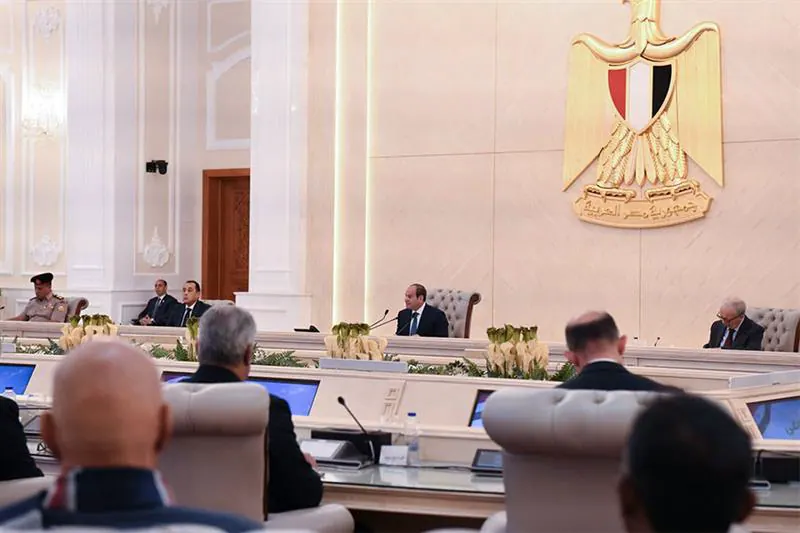
Egyptian President Abdel-Fattah El-Sisi stated on Tuesday that Egypt possesses "huge resources" that need to be better utilized to address the country's economic and regional challenges. He made these remarks at a gathering of high-ranking officials, including Prime Minister Mostafa Madbouly, cabinet ministers, governors, and military and police commanders, at the Strategic Command headquarters in the New Capital. El-Sisi highlighted the economic shocks Egypt has faced since 2020, including the COVID-19 pandemic, the Russia-Ukraine war, and the war in Gaza.
El-Sisi emphasized that regional instability has significantly impacted Egypt's revenues, particularly the Suez Canal, which has lost around $20 billion in recent years. He stressed the need to optimize Egypt's resources, stating that the country has the tools to achieve positive results. The president also underscored efforts to increase Egypt's water resources through seawater desalination, water treatment, and recycling. This comes as Egypt faces water scarcity, a pressing issue that needs to be addressed.
The Grand Ethiopian Renaissance Dam was another topic discussed by El-Sisi, who said Egypt is giving diplomacy and peaceful solutions "space" to address the issue. However, he firmly stated that this would not come at the expense of Egypt's existence and its people. El-Sisi described Egypt's position on the dam as part of its broader approach to resolving regional disputes peacefully, while emphasizing that protecting the country's water resources remains essential.
El-Sisi also touched on the period of instability Egypt experienced between 2011 and 2013, which he described as "a period of weakness." He noted that the price Egypt paid during that time was very high and highlighted the attempts to undermine the state through various means, including social media. The president stressed the importance of maintaining domestic cohesion and public awareness, saying Egyptians' awareness is a key defense against attempts to destabilize the country.
The Palestinian issue remains a central concern in the Middle East, according to El-Sisi, who stated that the failure to resolve it is a major cause of regional instability. He emphasized that the two-state solution is the only path to lasting peace and stability. El-Sisi also expressed Egypt's support for the security and stability of its Gulf Arab allies and the importance of maintaining freedom of navigation in international waterways in accordance with international law.
The meeting also covered government performance and public services, with various ministers presenting their main achievements over the past decade. They highlighted efforts to improve the quality of services provided to citizens and address long-standing challenges. El-Sisi stressed the need to take all necessary steps to improve services and ensure they better meet citizens' needs. He directed the interior ministry to reduce the costs associated with vehicle licensing and reiterated the importance of treating citizens well when they access government services.
El-Sisi concluded by emphasizing that Egypt's ability to overcome its challenges depends on making proper use of its available resources, improving public services, strengthening institutions, and maintaining social cohesion. He called for greater institutional coordination to harness Egypt's capabilities, maintain public morale, and prevent frustration. The president also highlighted training programs provided by the Egyptian Military Academy to newly appointed employees across government ministries, aimed at giving them a comprehensive understanding of Egypt's national security considerations.
Key points
- Egypt faces significant economic and regional challenges, including water scarcity and instability in the Middle East.
- President El-Sisi emphasizes the need to optimize Egypt's resources and improve public services to address these challenges.
- The Grand Ethiopian Renaissance Dam and the Palestinian issue remain key concerns for Egypt's national security and regional stability.