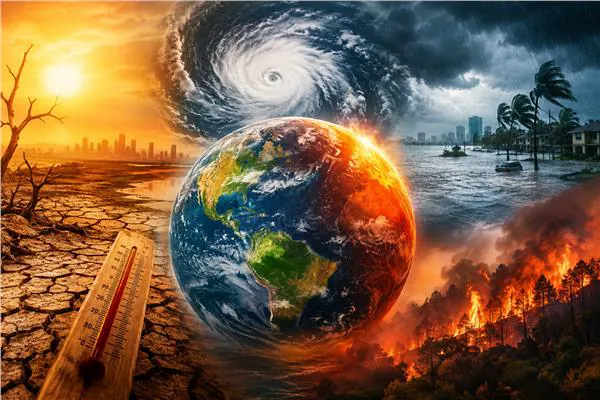
The El Niño climate phenomenon has reached a critical phase, adding pressure to a planet already experiencing unprecedented high temperatures and extreme weather events. With the global average surface temperature rising by 1.5 degrees Celsius compared to pre-industrial levels, the conditions have changed significantly. According to scientific estimates, the additional heat associated with a strong El Niño event could lead to around 451,000 heat-related deaths by February 2027.
Dr. Alaa Serhan, a professor of environmental economics, stated that the current climate changes have led to a 1.5-degree Celsius rise in Earth's average temperature, altering environmental conditions significantly. He emphasized that the emergence of El Niño at this time exacerbates the climate crisis, particularly as it coincides with increasing extreme weather events, including forest fires and record-high temperatures in various parts of the world.
El Niño is a natural climate phenomenon that occurs when the surface temperature of the equatorial Pacific Ocean rises more than usual, leading to changes in atmospheric circulation and global weather patterns. This can result in heavy rainfall and floods in some areas, while other regions experience droughts and heatwaves. The phenomenon's impact is not limited to the Pacific or nearby regions, as it can affect distant areas through changes in atmospheric circulation.
A recent study by Climate Impact Lab at the University of Chicago estimates that the additional heat associated with a strong El Niño event could lead to approximately 451,000 heat-related deaths by February 2027. These numbers represent statistical estimates and not actual death tolls. The study focuses on heat-related deaths and does not account for all potential health or economic impacts of droughts, wildfires, floods, and food and water disruptions.
The African region, particularly the Sahel, is expected to be highly vulnerable to heat-related deaths, with an estimated 66,800 additional deaths during the study period. Nigeria is projected to experience around 31,400 additional deaths, followed by Sudan with 17,500. The risk of heatwaves is exacerbated in areas with limited access to healthcare, cooling, and clean water, as well as high numbers of workers in exposed sectors.
The impacts of El Niño are not limited to Africa, as regions in South and Southeast Asia face risks related to changing rainfall patterns and rising temperatures. Indonesia, India, the Philippines, Vietnam, Thailand, and Cambodia are among the countries expected to experience significant heat-related deaths and other climate-related impacts. Rising temperatures and drought in some areas are also linked to increased wildfire risks and deteriorating air quality.
The effects of El Niño are also being felt in the Americas, with Brazil and the United States expected to experience significant heat-related deaths. According to estimates, Brazil may see around 13,300 additional deaths, while the United States could experience around 3,500. This highlights the global nature of El Niño, as changes in the Pacific can impact weather patterns in distant regions.
Key points
- El Niño may cause 451,000 heat-related deaths by February 2027
- African region highly vulnerable to heat-related deaths
- Climate change and El Niño compound extreme weather events