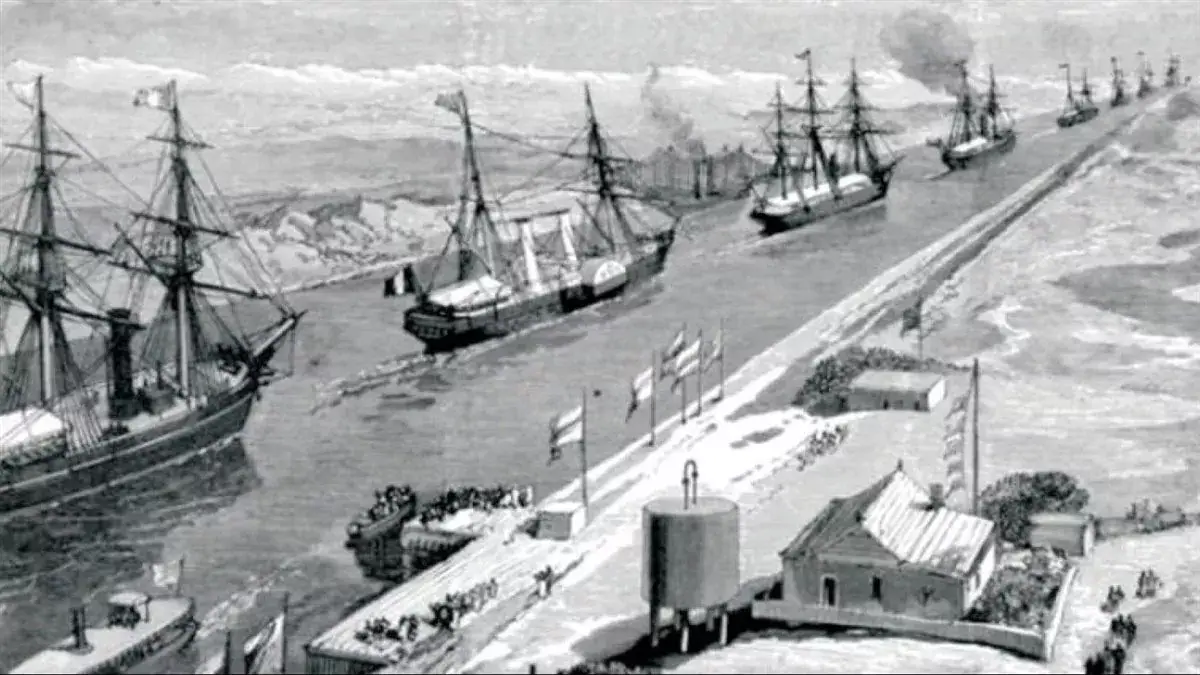
On November 17, 1869, Egypt witnessed an extraordinary event that changed the world's trade and navigation map with the official opening of the Suez Canal. This massive project linked the Mediterranean Sea to the Red Sea, creating a shorter route between Europe and Asia, and became one of the most important waterways in the world. The canal's opening was not just an engineering achievement but marked the beginning of a new era in modern Egyptian history, combining aspirations for modernization and renaissance with colonial competition and economic struggles that lasted for decades.
The idea of connecting the Mediterranean and Red Seas was not new, with ancient attempts to create waterways linking the Nile to the Red Sea. However, the modern project emerged in the 19th century when French diplomat Ferdinand de Lesseps proposed digging a direct sea canal through the Isthmus of Suez. On November 30, 1854, de Lesseps obtained the first concession from Egyptian Viceroy Muhammad Sa'id Pasha to establish a company to implement and manage the project. The Suez Canal Company was founded in 1858 with French and Egyptian participation. Britain initially opposed the project, fearing growing French influence in Egypt and threats to its trade interests linked to the India route.
Construction began on April 25, 1859, in the area of Ferdan, near the current site of Port Said, with thousands of Egyptian workers involved under harsh conditions and significant reliance on manual tools and a corvée system in the early years. The excavation required removing huge amounts of sand and soil, creating ports and supply facilities, and providing water for workers. It took nearly ten years to complete, with the canal stretching approximately 164 kilometers at its opening. The project was an unprecedented engineering feat, achieved with the participation of thousands of Egyptians alongside engineers and workers of various nationalities.
The Suez Canal was officially opened on November 17, 1869, with a grand ceremony attended by European monarchs and dignitaries. Khedive Ismail aimed to make the event an international spectacle reflecting modern Egypt. The Empress Eugénie, wife of Napoleon III of France, was among the prominent attendees. The procession of ships began in Port Said, led by the French imperial yacht 'L'Empereur,' carrying Empress Eugénie, marking the beginning of a new era in international navigation.
The Suez Canal's impact on global trade and Egypt's economy has endured for over 150 years. It remains a vital waterway, connecting Europe to Asia and saving ships from having to circumnavigate Africa. The canal is a significant source of foreign currency for Egypt and grants the country strategic weight in international trade, energy movement, and global supply chains. Recent crises affecting navigation in the Red Sea have shown that any disruption in the canal's operation affects global trade, transportation costs, and commodity prices.
The Suez Canal has undergone significant changes in ownership and management since its opening. In 1875, Egypt was forced to sell its shares in the Suez Canal Company to Britain due to financial difficulties. This sale increased British influence within the company and reduced Egypt's ability to affect its management. The canal remained under foreign-controlled administration until July 26, 1956, when President Gamal Abdel Nasser nationalized the Suez Canal Company. This decision led to the tripartite aggression against Egypt in October 1956, involving Britain, France, and Israel, but the canal remained under Egyptian administration.
Today, the Suez Canal continues to play a critical role in global maritime trade. Its strategic importance is undeniable, and any disruption in its operation has far-reaching implications for the global economy. As the world commemorates 157 years since the Suez Canal's opening, its legacy as a monumental engineering achievement and a pivotal element in international trade and diplomacy endures.
Key points
- The Suez Canal, opened on November 17, 1869, revolutionized global trade by connecting the Mediterranean and Red Seas, creating a shorter route between Europe and Asia.
- The canal's construction was a massive undertaking that involved thousands of workers and was completed in nearly ten years, marking an unprecedented engineering feat at the time.
- The Suez Canal remains a vital waterway and a significant source of foreign currency for Egypt, with its strategic importance in global trade and diplomacy continuing to endure.