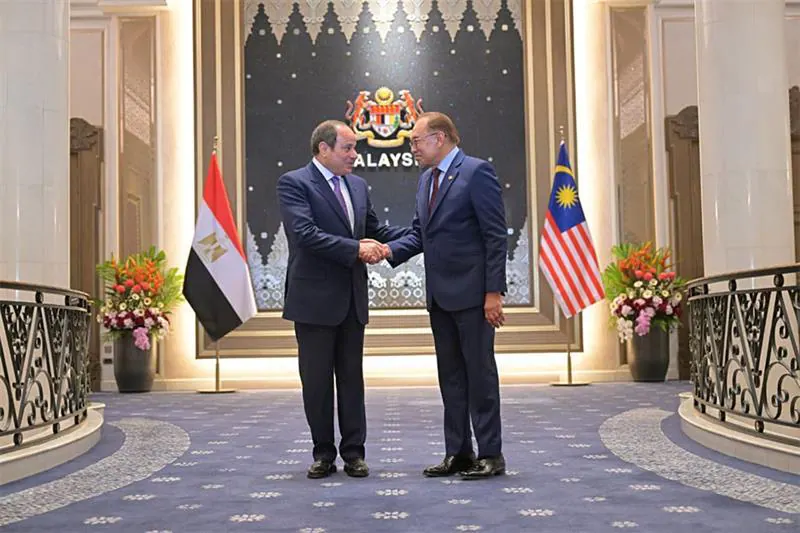
Egyptian President Abdel-Fattah El-Sisi concluded a two-day state visit to Malaysia on October 10, 2026, marking his first visit to the country. The visit was at the invitation of Malaysian King Sultan Ibrahim. During the visit, El-Sisi met with Sultan Ibrahim and Prime Minister Anwar Ibrahim, with whom he discussed various aspects of bilateral relations, including politics, trade, investment, defense, and regional issues.
Egypt and Malaysia have enjoyed strong diplomatic relations since November 10, 1959, built on mutual respect and shared values. The two nations have strengthened their ties over the decades, with a significant boost in recent years. On November 10, 2024, in Cairo, Prime Minister Ibrahim and President El-Sisi agreed to elevate their countries' relations to a strategic partnership, aiming to create a more dynamic and resilient partnership across various sectors.
The strategic partnership between Egypt and Malaysia focuses on enhancing trade and investment, particularly in areas such as agriculture, the halal industry, education, and renewable energy. Both countries recognize their strategic positions as economic hubs and gateways to each other's markets and those of the Association of Southeast Asian Nations (ASEAN), the Arab world, Africa, and Europe. They agreed to convene the Second Joint Commission Meeting and the Second Bilateral Consultations at the earliest opportunity.
President El-Sisi and Prime Minister Ibrahim also discussed defense and security cooperation, acknowledging the longstanding cordial relations between their countries. They stressed the importance of further strengthening these ties, built on mutually beneficial cooperation. The two leaders emphasized the significance of people-to-people exchanges in strengthening friendship between their nations, including scholarship exchanges, human capital development, and academic cooperation.
Malaysia reaffirmed its commitment to strengthening capacity-building cooperation with Egypt in mutually agreed priority areas, including through the Malaysian Technical Cooperation Programme. The two countries will continue to expand their academic ties through collaborative research, language programs, and student exchange initiatives that strengthen cultural, religious, and scientific cooperation. They also emphasized the importance of air connectivity in supporting closer economic cooperation and encouraged their national airlines to explore opportunities for greater collaboration.
On regional issues, the two leaders reaffirmed that the Palestinian issue remains a core concern in West Asia and the Middle East. They stressed the importance of achieving a just and lasting peace and the implementation of the two-state solution, guaranteeing the establishment of an independent and sovereign Palestinian state. They also called for the need to consolidate the ceasefire in the Gaza Strip, facilitate the flow of humanitarian aid, and ensure the full implementation of United Nations Security Council Resolution 2803.
The two leaders expressed their commitment to working together towards achieving peace and stability in the Gulf region and West Asia, including in the Strait of Hormuz. They underscored the importance of ensuring freedom of navigation in accordance with international law. Key aspects of their cooperation include enhancing economic ties, promoting peace and stability in the region, and strengthening people-to-people exchanges.
Key points
- Egypt and Malaysia have elevated their bilateral relations to a strategic partnership, focusing on trade, investment, and regional security.
- The two countries aim to enhance cooperation in areas such as agriculture, education, and renewable energy.
- They also stressed the importance of achieving a just and lasting peace in the Palestinian issue and the implementation of the two-state solution.