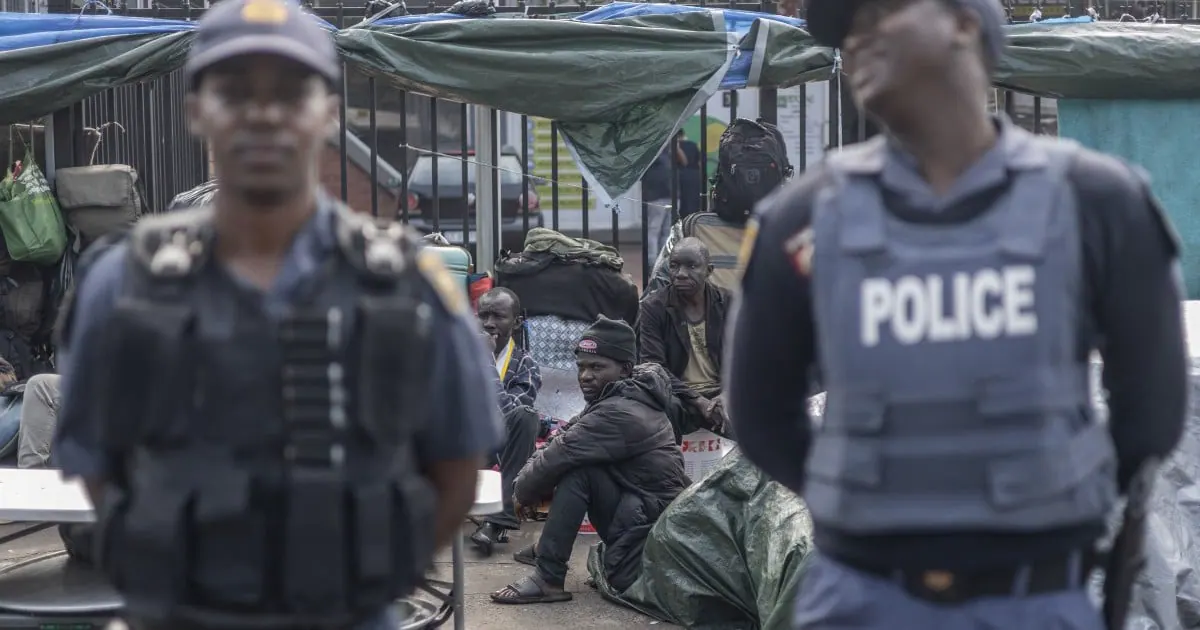
South Africa's police force has a total of 187,000 personnel, however, Professor Christiaan Bezuidenhout of the University of Pretoria estimates that only about 25,000 operational officers may be available to fight crime at any given time. This significant disparity raises questions about the effectiveness of the police force in addressing crime. Bezuidenhout's estimates suggest that the actual number of operational officers is substantially lower than the often-cited figure of 187,000.
The 187,000 figure includes approximately 155,000 sworn police officers and 33,000 civilian support staff. However, Bezuidenhout notes that civilian employees, such as mechanics, administrative personnel, and cleaners, do not engage in frontline policing. Furthermore, factors such as investigations, suspensions, leave, absenteeism, and medical or psychological reasons also affect the availability of sworn officers. These factors contribute to a significant gap between the headline number of police officers and those actually available for frontline policing.
Bezuidenhout estimates that there are around 100,000 operational police officers available to work, but even this figure does not translate to 100,000 officers being on duty simultaneously. Due to the 24/7 nature of policing, officers work in shifts, which affects their availability. Bezuidenhout calculates that approximately 25,000 operational officers are available at any given time to cover 1,165 police stations across South Africa's nine provinces, as well as borders, harbours, and other areas.
A comparison with United Nations guidelines reveals a stark difference in police-to-population ratios. The UN recommends about 300 police officers per 100,000 people, whereas South Africa's ratio, based on Bezuidenhout's estimates, is roughly 59 police officers per 100,000 people. This translates to approximately one operational police officer for every 2,564 residents. Bezuidenhout describes this as a significant shortfall, highlighting a major challenge facing the police force.
Bezuidenhout argues that the problem extends beyond the number of officers, citing issues with the police structure, which he describes as "extremely top-heavy." A large proportion of the police budget goes towards senior management salaries rather than operational policing. He also points to absenteeism and officers not performing their duties. However, he emphasizes that his criticism is not aimed at frontline officers who work in challenging conditions.
Rebuilding trust between police and communities is essential, according to Bezuidenhout. He believes that community and sector policing have produced some positive results but argues that the broader model has failed. Addressing these problems will require changes throughout the police system, including recruitment and vetting. Bezuidenhout advocates for proper vetting and psychological testing of recruits, as well as selecting officers who are committed to protecting their communities.
Despite concerns, Bezuidenhout sees some reason for hope, citing recent revelations and investigations into alleged wrongdoing within the police as potential steps towards addressing systemic problems. He emphasizes the importance of good officers and whistleblowers feeling able to come forward, while also acknowledging the risks faced by those who do so. Bezuidenhout believes that the system can reach a "tipping point" where more police officers will support investigations into wrongdoing, ultimately leading to a more effective police force.
Key points
- Professor Christiaan Bezuidenhout estimates that only about 25,000 operational police officers are available at any given time in South Africa.