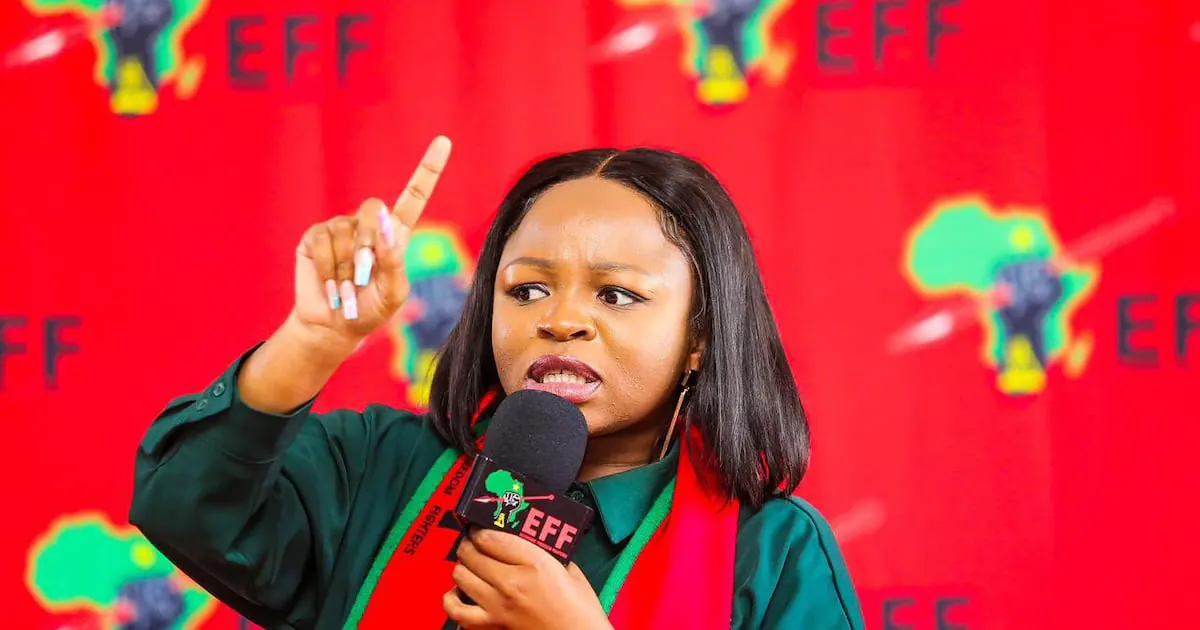
South African EFF MP Naledi Chirwa-Mpungose has filed an answering affidavit in response to a defamation case brought by March and March movement leader Jacinta Ngobese-Zuma. Chirwa-Mpungose denies that she accused Ngobese-Zuma of killing or facilitating the death of 19-year-old Nhlamulo Sambo. The case centers on a Facebook post republished by Chirwa-Mpungose on June 1, which Ngobese-Zuma claims created the impression that she was responsible for Sambo's death.
Chirwa-Mpungose argues that Ngobese-Zuma has misrepresented her Facebook post and parliamentary remarks, which she claims were political commentary on xenophobia, Afrophobia, tribalism, and violence. She says her comments were not an allegation that Ngobese-Zuma was responsible for Sambo's death. Chirwa-Mpungose wants the high court in Johannesburg to dismiss the application, arguing that Ngobese-Zuma has failed to establish the factual and legal foundation for the relief she seeks.
The dispute revolves around the interpretation of Chirwa-Mpungose's Facebook post and parliamentary speech. Ngobese-Zuma's founding affidavit alleges that Chirwa-Mpungose's comments implied that she had caused or set in motion a chain of events that led to Sambo's death. However, Chirwa-Mpungose disputes this interpretation, saying she did not understand the statement as an allegation that Ngobese-Zuma personally caused Sambo's death. She claims her comments were directed at condemning tribalism, xenophobia, and conduct capable of creating social division and violence.
Chirwa-Mpungose also disputes Ngobese-Zuma's interpretation of her parliamentary comments, saying she did not mention Ngobese-Zuma by name and did not accuse her of killing Sambo. The EFF MP argues that the court must assess her statements objectively and within the context in which they were published, rather than through Ngobese-Zuma's personal interpretation. She claims that Ngobese-Zuma has failed to distinguish between an express accusation of wrongdoing and political commentary concerning broader social and political issues.
Chirwa-Mpungose challenges Ngobese-Zuma's claims of threats, hostility, and reputational damage, saying she has not identified a specific threat, incident, or act of harm caused by her post. The EFF MP argues that the existence of comments, criticism, or disagreement after a social media post does not, without more, establish actionable defamation. She also denies that she acted with an intention to injure Ngobese-Zuma's reputation, saying her purpose was to participate in a public debate about xenophobia, Afrophobia, and tribalism.
The case has significant implications for freedom of expression in South Africa. Chirwa-Mpungose invokes section 16(1) of the constitution, which protects freedom of expression, and argues that her comments constituted political expression on matters of substantial public interest. She claims that the constitutional protection of political speech cannot simply be displaced because the subject of the criticism takes offence or says their reputation has been damaged.
Chirwa-Mpungose rejects Ngobese-Zuma's demand for an apology and retraction, saying she cannot be expected to apologise for exercising her constitutional right to freedom of expression. The EFF MP's defence also relies on the defence of reasonableness and public interest, arguing that her comments were lawful because they concerned matters of legitimate public concern and were reasonable in the circumstances. The court will now have to consider the merits of the case and determine whether Chirwa-Mpungose's comments were defamatory or constituted legitimate political expression.
Key points
- Chirwa-Mpungose denies accusations of defamation by Ngobese-Zuma over comments on Nhlamulo Sambo's death
- The case centers on the interpretation of Chirwa-Mpungose's Facebook post and parliamentary remarks
- Chirwa-Mpungose argues that her comments were political commentary on xenophobia, Afrophobia, tribalism, and violence, and did not accuse Ngobese-Zuma of killing Sambo