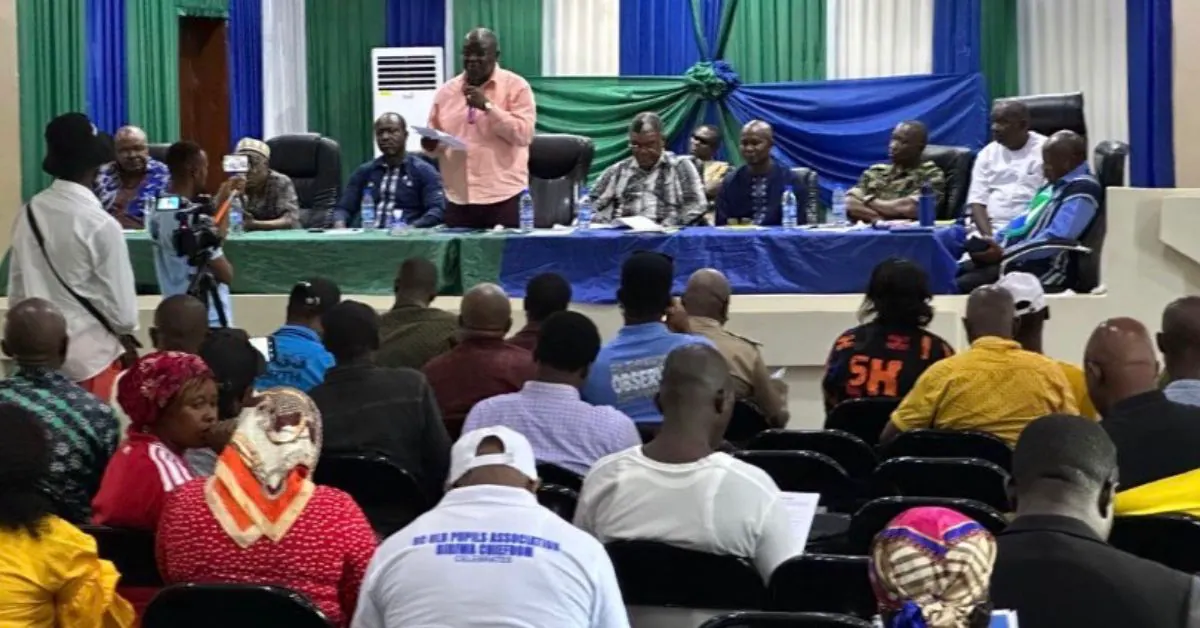
Chief Electoral Commissioner and Chairman of the Electoral Commission for Sierra Leone (ECSL), Edmond Sylvester Alpha, has called on citizens and stakeholders in the Northern Province to critically examine the Commission's work as it validates its Strategic Plan for 2025-2029 and key institutional policies. This call was made on Wednesday, September 30, 2026, at the Bombali District Council Hall in Makeni during a Regional Stakeholder Validation Workshop.
The workshop, attended by representatives of political parties, security institutions, civil society organisations, women and youth groups, traditional leaders, religious communities, and development partners, aimed to promote collective ownership of the strategic plan. Alpha acknowledged that public trust in the Commission in the North had not been easily established and that the concerns surrounding the Commission's credibility were legitimate.
According to Alpha, a credible electoral system cannot be built in Freetown alone but must reflect the experiences and voices of citizens in Bombali, Tonkolili, Koinadugu, and Falaba. The draft Strategic Plan 2025–2029 was developed from internal assessments, lessons from previous elections, and recommendations from local and international observers.
The proposed framework seeks to strengthen the Commission's professional and inclusive workforce, expand year-round civic and voter education, improve electoral operations, and modernise digital systems while protecting voter data and strengthening cybersecurity. The plan focuses on institutional and staff development, electoral education and participation, electoral operations, and information and communication technology and data management systems.
The workshop also provided an opportunity for stakeholders to validate four institutional policies covering stakeholder consultation, regulation, information management, and the recruitment and management of ad-hoc electoral staff. Alpha made three commitments, including ensuring that the final strategic plan reflects regional realities, that the validated policies are implemented in practice, and that submissions made during the consultations are documented, considered, and reported back to stakeholders.
Alpha encouraged ordinary citizens, including traders, transport workers, teachers, students, religious leaders, chiefs, and youth representatives, to freely express their concerns and challenge the Commission where necessary. He urged participants to assess whether the proposed objectives are realistic, the indicators measurable, and the plan capable of addressing operational and public-trust challenges.
The ECSL Chairman declared the validation workshop open and called for candid and constructive deliberations as the ECSL continues the process of finalising its Strategic Plan and institutional policies. He emphasised that the Commission was not seeking "blind trust" but a working relationship based on evidence, follow-through, and mutual respect.
Key points
- ECSL Chairman Edmond Sylvester Alpha urges Northern stakeholders to scrutinize the Commission's Strategic Plan for 2025-2029.
- The Strategic Plan 2025–2029 focuses on institutional and staff development, electoral education and participation, electoral operations, and information and communication technology and data management systems.
- Alpha made three commitments to ensure the final strategic plan reflects regional realities, validated policies are implemented, and submissions are documented and reported back to stakeholders.