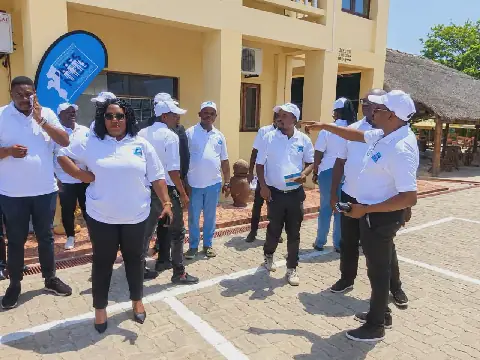
The Eswatini College of Technology (ECOT) has called on industries to become active partners in training graduates, citing the mismatch between qualifications produced by institutions and employers' requirements as a threat to the country's skills development ambitions. Principal Dr Sicelo Kunene emphasized that training institutions cannot independently address the changing demands of the labor market. He made these remarks during the inaugural Lutsi Graduation Indaba, held at the college's boardroom ahead of its 24th Graduation Ceremony.
Kunene highlighted that the economy is experiencing rapid industrial and technological changes, increasing the demand for new skills while exposing weaknesses in the relationship between training institutions and employers. He challenged stakeholders to consider whether institutions were preparing students for jobs that actually existed and whether curricula reflected technological developments. Kunene also emphasized the need for industry involvement in shaping training programs, including curriculum development, identifying skills gaps, and providing industrial attachments.
The Construction Industry Council (CIC) has pledged to strengthen its partnership with ECOT, particularly in addressing shortages of specialized engineering, technical, and artisan skills within the construction industry. CIC Chief Executive Officer Maqhawe K. Mnisi said the construction sector is increasingly embracing digital technologies, requiring training institutions to align their curricula with emerging industry demands. He identified digital construction, project management, and advanced technical competencies as priority areas.
Mnisi disclosed that CIC had already supported ECOT through the provision of WinQS software for quantity surveyors and intended to deepen its involvement in the institution's transformation. He also announced that CIC was establishing a Construction Industry Committee to bring together stakeholders to identify challenges and develop a roadmap for addressing skills shortages. CIC aims to strengthen the connection between graduates and employers through internships, workplace learning, mentorship, and professional development.
CIC also wants ECOT to become a national hub for construction innovation, particularly in affordable housing, alternative building materials, construction waste recycling, and artificial intelligence-enabled construction management. Mnisi advocated for a shift towards a circular construction economy, promoting resource efficiency, material recovery, recycling, and reuse. He sees this transition as an opportunity for graduates to develop sustainable construction solutions, reduce waste, and explore entrepreneurship.
ECOT offers programs in engineering, construction, information and communication technology, automotive studies, hospitality, and business, which can contribute to national development and private sector productivity. The institution is also investing in digital innovation, with ICT students developing practical solutions, including an institutional website, server, and digital admissions and registration application. ECOT's Artificial Intelligence Hub positions it to participate in emerging technologies.
Through a partnership with the United Nations Development Programme (UNDP), CIC has supported a program connecting graduates with construction and consultancy firms, with some beneficiaries securing permanent employment. The partnership between ECOT and CIC aims to address the skills gap in the construction industry and promote sustainable development in Eswatini. Key stakeholders, including the Minister for Education and Training, attended the Lutsi Graduation Indaba to discuss the country's skills development ambitions.
Key points
- The partnership between ECOT and CIC aims to address the mismatch between qualifications produced by institutions and employers' requirements in Eswatini's construction industry.
- CIC has pledged to support ECOT in addressing shortages of specialized engineering, technical, and artisan skills within the construction industry.
- The partnership seeks to promote sustainable development in Eswatini through the development of sustainable construction solutions and a circular construction economy.
Reporting sources
- ECOT, CIC join forces to address construction skills gaps · Times of Swaziland