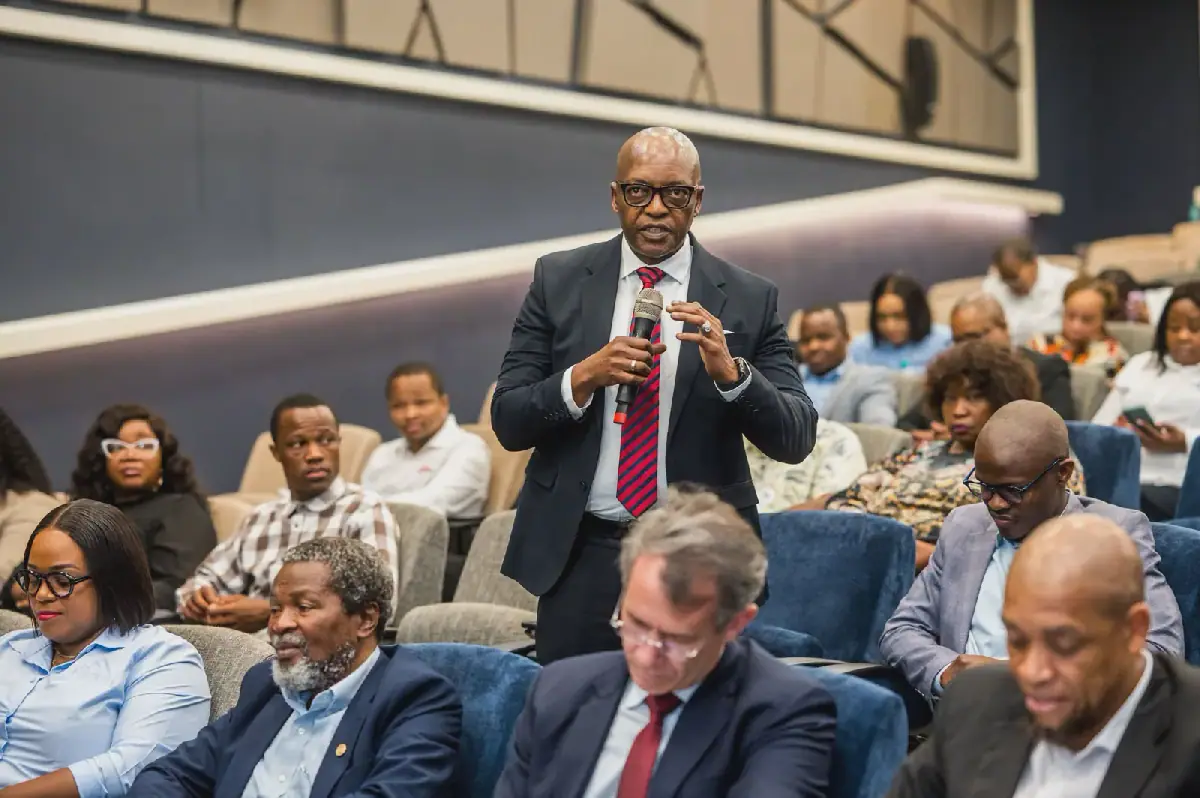
Economist Sanele Sibiya has supported Business Eswatini CEO Nathi Dlamini's call for the government to slow down its borrowing pace. Sibiya emphasized that Eswatini needs a significant shift towards stronger debt management and fiscal discipline. He noted that public debt has exceeded the 40% of gross domestic product (GDP) threshold and is approaching 50%. This warning comes as public debt stood at E42.1 billion, equivalent to 40.4% of GDP, according to the Central Bank of Eswatini's Recent Economic Development report.
Dlamini made the call directly to Minister for Finance Neal Rijkenberg during the launch of the 2026 Annual Income Tax Return Filing Season. The private sector is increasingly concerned about the direction of public debt, particularly since Eswatini had previously maintained prudent expenditure and debt-management practices. The country's public debt had been kept below 38% of GDP for almost eight years, earning recognition for maintaining lower debt levels compared to many regional countries.
Sibiya highlighted that the rising debt burden is particularly concerning because interest payments alone are already surpassing planned government spending on education. He described this situation as a case of crowding out, where government's social spending comes under pressure as more resources are directed towards servicing debt. The economist questioned the argument that Eswatini could continue increasing its debt towards the regional average of 60% of GDP.
Sibiya's analysis suggests that the country's optimal debt ratio is below 40%, citing the small and vulnerable nature of the economy, its single-digit growth rate, and the rapid increase in debt. He emphasized that borrowing is not generating commensurate growth, and the country is borrowing at a diminished capacity to repay. This situation raises concerns about the sustainability of Eswatini's debt trajectory.
The Central Bank of Eswatini's report also highlighted the need for careful management of public debt. The report noted that the country's debt levels have increased significantly, and there is a need for fiscal prudence to ensure debt sustainability. The bank's concerns align with those of Sibiya and Dlamini, who are advocating for a more cautious approach to borrowing.
Business Eswatini's CEO, Nathi Dlamini, emphasized that the private sector's concern is not simply about the existence of public debt but about the speed at which the debt burden is increasing. He reminded the minister that Eswatini had previously demonstrated prudent debt management, and there is a need to return to this approach. The country's economic growth and social spending are likely to be affected if the debt trajectory is not managed carefully.
The debate on Eswatini's debt management is ongoing, with various stakeholders weighing in on the issue. The government's response to these concerns will be crucial in determining the country's economic trajectory. As the situation stands, there is a growing consensus that a more cautious approach to borrowing is necessary to ensure fiscal sustainability and maintain economic stability.
Key points
- Eswatini's public debt has exceeded 40% of GDP, and economists are calling for a shift towards stronger debt management and fiscal discipline.
- The country's optimal debt ratio is considered to be below 40%, due to its small and vulnerable economy, single-digit growth rate, and rapid increase in debt.
- Interest payments on the debt are already surpassing planned government spending on education, raising concerns about the impact on social spending.