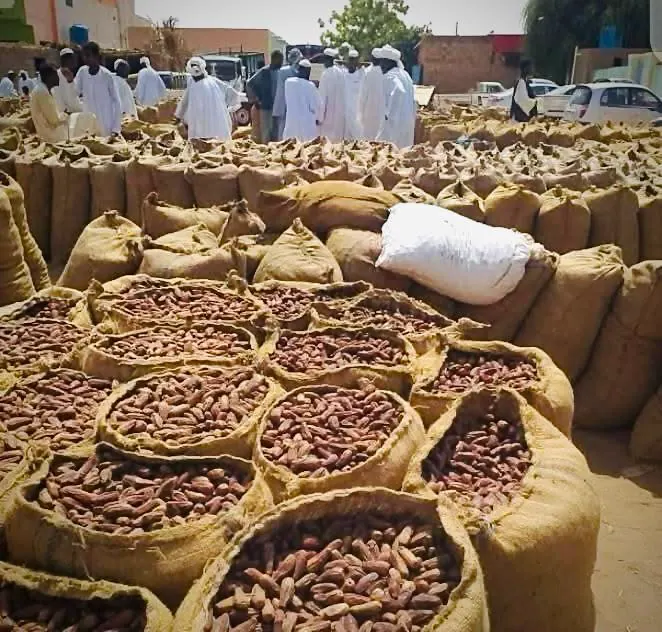
The economic situation in Sudan's Northern State has taken a turn for the worse, with the cost of living skyrocketing due to the increasing dollar rate, which has surpassed 8,000 Sudanese pounds. This surge has led to a significant rise in the prices of basic commodities, further straining the already vulnerable households. The value of dates, a primary source of income for thousands of families in the region, has drastically decreased.
In the past, a jowl of dates was equivalent to two jowls of wheat; however, its value has now dwindled to that of only one and a half kilograms of beef. This sharp decline has considerably eroded the purchasing power of dates, despite being a crucial component of many families' daily necessities. The price of a kilogram of meat currently ranges between 70,000 and 80,000 pounds, while an ardab of wheat, a staple food for the state's residents, has exceeded 700,000 pounds.
The rising costs have not spared bread, with two pieces now costing 1,000 pounds. The average family requires between 20,000 and 25,000 pounds to afford bread for just two meals. As a result, some families have had to reduce their daily consumption to one and a half or even just two meals. This economic strain is compounded by a shortage of liquidity and difficulties with bank transfers, particularly through the "bنكك" application, making it even harder for people to purchase essentials and pay their obligations.
The crisis has expanded beyond the most impoverished groups, affecting even relatively well-off families who struggle to manage their expenses. Citizens describe the economic collapse as a more pressing concern than direct warfare, given the ongoing conflict and the lack of imminent solutions through military victory or negotiation. Many link the continuation of the war to the decline in economic activity and the surge in prices of goods and services.
The agricultural sector is also feeling the pinch, as the Northern State relies heavily on pumps for irrigation, which require electricity or fuel. The unstable power supply and rising fuel costs have made irrigation more expensive and challenging, particularly with the weak rainfall this year. Farmers face significant hurdles in preparing for the winter season, with increased costs for land preparation, seeds, fertilizers, and fuel.
These rising costs coincide with a decline in crop yields, including dates. Farmers and business owners also complain about increased taxes, fees, and commercial licenses, which they believe place an excessive financial burden on producers when their ability to cover basic costs is already compromised. In response to the challenges of the winter season, local organizations and authorities are encouraging farmers to form associations to provide support.
Despite the establishment of a high committee to ensure the success of this year's winter agricultural season, concerns remain about the potential for a repeat of past experiences, especially given the ongoing high costs, weak financing, and uncertainty about the extent of support that will actually reach farmers. Moreover, the transportation and marketing of dates pose additional problems, with increased difficulty and cost in transporting the crop due to restrictions on traveling through certain routes.
Key points
- The economic crisis in Sudan's Northern State has led to a significant increase in the cost of living.
- The value of dates, a staple commodity, has drastically decreased.
- The agricultural sector faces significant challenges, including rising costs and decreased crop yields.