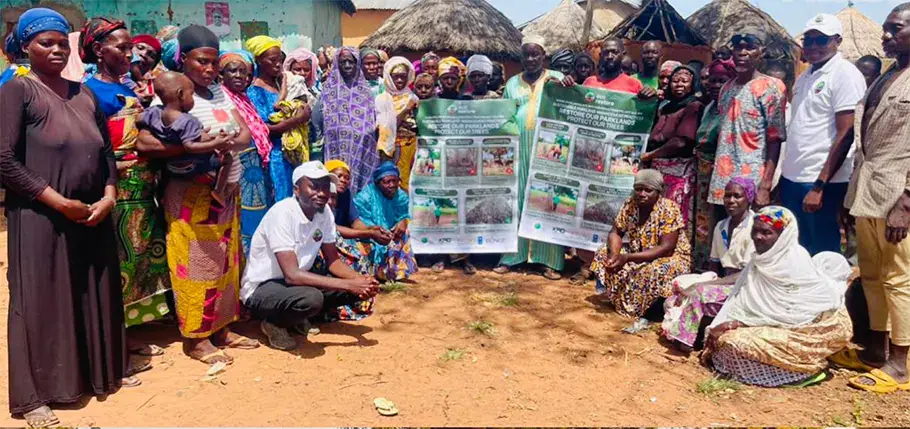
Eco Restore, a climate-smart organisation in Ghana, has trained 1,448 farmers from 27 communities in the North East and Savannah regions on sustainable parkland management and bushfire prevention. The training, which took place from October 20 to 31, 2026, aimed to equip farmers with practical knowledge and skills to protect their trees and manage their parklands sustainably. The initiative covered 17 communities under the Ghana Shea Landscape Emission Reductions Project (GSLERP), six communities under the Fuji Oil Ghana (FOG) Project, and four communities under the Golden Forest (GF) Project.
The training, led by Abubakari Amadu Baaba, Assistant Operations Manager for Tree Growing at Eco Restore, focused on preventing bushfires, protecting young trees, and improving parkland management ahead of the harmattan season. Baaba emphasized the importance of creating firebreaks, clearing dry vegetation around trees, and guarding young trees against livestock to reduce damage and improve tree survival. The training also covered responsible use of insecticides to protect insect pollinators and edible caterpillars, which are critical to biodiversity and food security.
A total of 750 men and 698 women participated in the training, with 167 farmers from the Golden Forest Project, 384 from the FOG Project, and 897 from GSLERP. The beneficiary communities included Sawaba, Boayini, and Zanguga in the West Mamprusi Municipality, as well as Naamiyala, Bongbini, and Gbangu in the East Mamprusi Municipality. The training is part of Eco Restore's annual community parkland protection initiative, which aims to promote zero burning and sustainable land management.
Adam Osman Wumbei, Assistant General Manager at Eco Restore, highlighted the organisation's commitment to promoting sustainable land management and zero burning. He emphasized the importance of educating farmers on the benefits of growing indigenous trees and advocating against harmful practices such as bush burning and unsustainable land management. Suweiba Yakubu, Media and Markets Officer at Eco Restore, urged farmers to use insecticides responsibly to protect biodiversity and food security.
Station Officer Akolbila Joseph of the Ghana National Fire Service in the North East Region commended Eco Restore and its partners for organising the training ahead of the dry season. He urged farmers to avoid careless burning and establish firebreaks to prevent fires from spreading across farms and communities. Inusah Sule, a tree farmer and chairman of the Boayini community's firefighting group, shared how residents use whistles to alert one another whenever a fire breaks out.
Karim Wumpua, a tree farmer from Gbangu, highlighted the benefits of indigenous trees beyond their environmental value. She uses nutritious baobab leaves to prepare soup for her household and expressed concern about bush burning and its effects on trees, farms, and soil fertility. The GSLERP project, funded by the Green Climate Fund, aims to promote sustainable land management and reduce emissions in Northern Ghana.
The project is jointly implemented by the Forestry Commission of Ghana and the Global Shea Alliance, with technical assistance from the United Nations Development Programme (UNDP Ghana). Eco Restore's initiative is part of a broader effort to promote sustainable land management and reduce the risk of bushfires in Northern Ghana. The organisation's efforts have been recognised by local authorities and farmers, who appreciate the importance of protecting trees and managing parklands sustainably.
Key points
- Eco Restore trains 1,448 farmers in Northern Ghana on sustainable parkland management and bushfire prevention.
- The training aims to promote zero burning and sustainable land management in Northern Ghana.
- The project is funded by the Green Climate Fund and jointly implemented by the Forestry Commission of Ghana and the Global Shea Alliance.