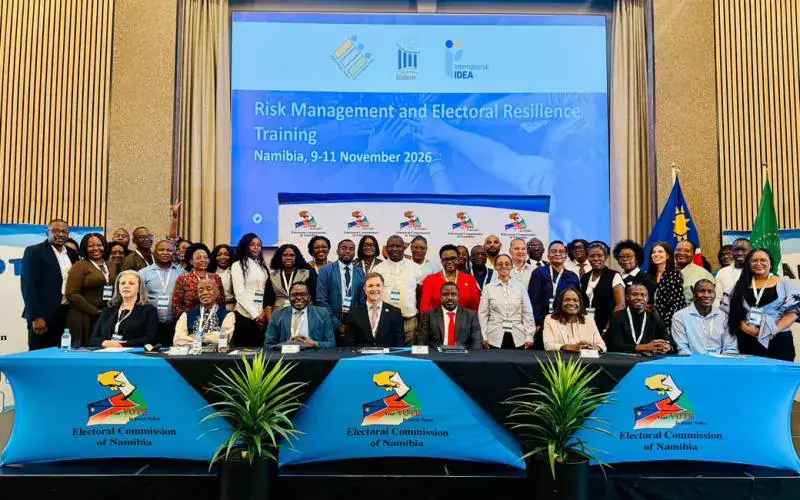
Electoral Commission of Namibia (ECN) chairperson Gerson Sindano has urged the commission to conduct elections fairly, transparently, and without fear or favour. This call was made during the opening of a three-day Risk Management and Electoral Resilience training workshop at the NamPower Convention Centre in Windhoek. Sindano stressed that electoral integrity is essential to public trust, citizen participation, and social cohesion. The workshop aims to strengthen the ECN's capacity to manage risks that could affect the electoral process.
Sindano's remarks come in light of challenges experienced during Namibia's 2024 Presidential and National Assembly elections. Some polling stations faced ballot-paper shortages, voter-verification equipment problems, and difficulties involving mobile polling teams. The Southern African Development Community (SADC) Electoral Observation Mission also raised concerns about unequal coverage of political parties in state-owned media during the election period. These challenges highlight the need for the ECN to improve its electoral processes.
The Electoral Act No. 5 of 2014 requires the ECN to manage elections fairly and impartially, without fear, favour, or prejudice. The commission must perform its duties independently of direction or interference by any authority or person. Sindano encouraged participants to share their experiences and learn from one another, as their different perspectives and expertise could help build stronger electoral systems.
The training workshop is organised by the International Institute for Democracy and Electoral Assistance (International IDEA), in collaboration with India's International Institute of Democracy and Election Management (IIIDEM). Sanjay Sharma, Associate Professor and Head of the Centre for Research and Innovation at IIIDEM, highlighted the importance of identifying potential problems before they disrupt the electoral process.
Sharma noted that most risks are ordinary things, such as delays in materials, gaps in training, or unclear messages to the public. However, if ignored, these ordinary risks can become serious problems. He cited India's Election Commission's experience in documenting its electoral risk management in a 2023 Manual on Electoral Risk Management.
The three-day workshop focuses on building a common understanding of electoral risks, identifying those most relevant to Namibia, and agreeing on practical steps to address them. Sindano said the ECN has an existing cooperation agreement with International IDEA through the ministry of international relations and trade. The commission also signed a memorandum of understanding with India's Election Commission in January 2026.
The ECN has benefited from five capacity-building training sessions through IIIDEM, following the memorandum of understanding with India's Election Commission. Sindano emphasized that managing risks is not enough without preparing electoral bodies to continue operating when problems occur. The workshop aims to equip the ECN with the necessary skills to manage risks and maintain electoral resilience.
Key points
- The ECN chairperson emphasized the importance of conducting elections without fear or favour.
- The training workshop aims to strengthen the ECN's capacity to manage risks that could affect the electoral process.
- The ECN has signed a memorandum of understanding with India's Election Commission to enhance its electoral processes.
Reporting sources
- ‘Elections must be conducted without fear or favour’ – Sindano · Windhoek Observer