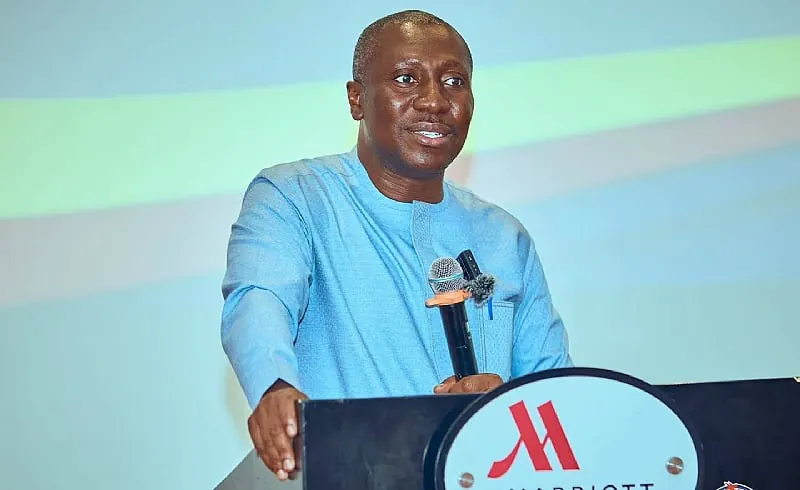
Minority Leader Alexander Afenyo-Markin has stated that the financial challenges facing the Electricity Company of Ghana (ECG) require comprehensive reforms rather than repeated tariff adjustments. He noted that the company's difficulties are structural and systemic, requiring reforms to make it financially sustainable and operationally efficient. Afenyo-Markin made these remarks after attending a luncheon organised in honour of former ECG managing directors and board chairpersons at the Accra Marriott Hotel on September 23, 2026.
Afenyo-Markin, who served as ECG's board chairman from September 29, 2024, to January 6, 2025, highlighted his experience with the company's considerable operational, financial, and institutional pressures. He questioned how ECG can deliver reliable electricity while meeting its financial obligations without continually transferring the consequences of inefficiencies to households and businesses. The Minority Leader noted that successive electricity tariff adjustments between April 2025 and September 2026 resulted in a cumulative increase of approximately 28.7 per cent.
Afenyo-Markin stressed that electricity pricing has direct consequences for household welfare, business production costs, employment, and economic opportunities. He warned that the Ghanaian consumer must not become the permanent financier of inefficiencies that the electricity sector has failed to confront. The Minority Leader acknowledged improvements in ECG's financial and operational performance but cautioned against interpreting the figures as evidence of a sustainable turnaround.
ECG's revenue increased from approximately GH¢19.03 billion in 2024 to GH¢22.11 billion in 2025, representing growth of 16.2 per cent. The company's reported loss after tax also declined from approximately GH¢8.26 billion to GH¢2.52 billion, an improvement of about 69.5 per cent. Additionally, new electricity connections increased by 31.3 per cent to 222,979, while prepaid customers accounted for approximately 53.5 per cent of the customer base.
However, Afenyo-Markin noted that the reduction in the reported loss after tax was materially supported by foreign exchange gains of approximately GH¢12.16 billion arising from the appreciation of the Ghana cedi against foreign-currency-denominated obligations. He argued that such accounting gains should not be confused with equivalent improvements in electricity sales, cash collections, or underlying operational efficiency. ECG's electricity purchase costs reached approximately GH¢34.8 billion in 2025, exceeding its reported revenue.
Afenyo-Markin proposed several measures to address ECG's financial challenges, including strict enforcement of the revised Cash Waterfall Mechanism and a unified customer database to eliminate fragmented records and duplicate accounts. He also recommended smart prepaid and remotely monitored meters to improve consumption measurement and reduce opportunities for manipulation. Furthermore, he called for stronger field inspections, consistent sanctions against electricity theft and meter tampering, and whistle-blower protection.
The Minority Leader identified faulty meters, inaccurate customer records, delayed billing, unbilled consumption, illegal connections, and weak payment reconciliation as major threats to ECG's financial recovery. He proposed three priority measures to address the company's financial obligations and the wider electricity sector's challenges, including effective regulatory oversight and accountability for deviations.
Key points
- ECG tariff increases are not a substitute for prudent financial management and effective revenue collection.
- Comprehensive reforms are required to address the structural and systemic challenges facing ECG.
- The company must intensify efforts to reduce losses, improve revenue collection, and control expenditure.