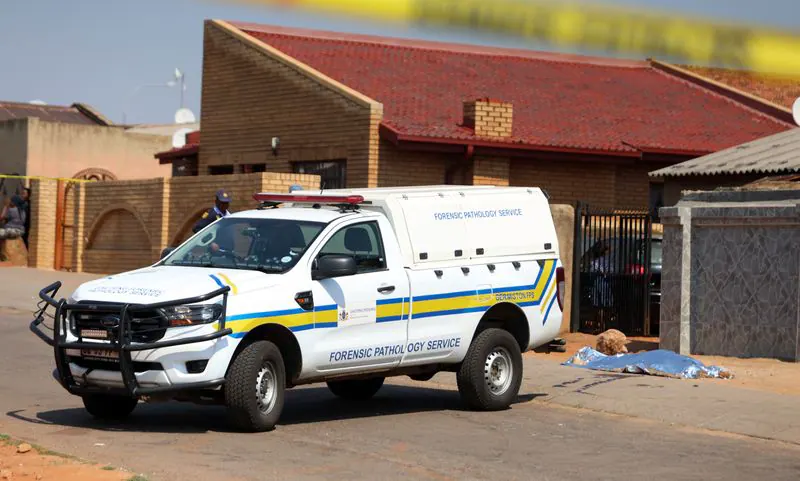
Boitumelo Nhlanzi, 23, was shot and killed on her way to work in Tembisa's Temong Section, Mapungubwe Street, early on September 28, 2026. Her belongings were taken, prompting a murder and robbery investigation. Nhlanzi's friend, Lydia Mpyana, received a phone call about the murder and initially feared approaching the scene, worried she might be the next target of a potential serial killer.
Community members and Nhlanzi's relatives gathered at the scene, where her body lay on the street. After forensic investigators removed her body, relatives cleaned her blood from the pavement. Nhlanzi's uncle, Motsatsi Khoza, expressed the family's excruciating pain and suggested that Nhlanzi might have been a victim of intimate-partner violence. According to Khoza, Nhlanzi's husband, who was called to inform him of her death, never arrived at the scene.
Police linked Nhlanzi's estranged husband to her murder and identified him as a person of interest. The SAPS Tembisa Tracking Team had been tracing him when the Midrand police found his vehicle with his body inside. The Gauteng SAPS spokesperson, Brigadier Brenda Muridili, stated that it is believed he may have ingested an unknown substance, and a post-mortem examination will determine the exact cause of death.
Ekurhuleni has been under scrutiny since the murder of Elizabeth "Tsontso" Moselakgomo in September 2026, which appeared to be part of a series of related killings. Nhlanzi's murder is not being investigated as part of the task team looking into the earlier cases. The SAPS has appointed a task team to investigate the previous cases related to the Ekurhuleni killings.
Police have pointed to similarities among the victims and the circumstances in which some of their bodies were found, but have cautioned against concluding that a serial killer may be operating in Gauteng. All 13 victims were black women in their 20s or 30s, and their cases are concentrated around Kempton Park, the R21 highway, Clayville, and Tembisa.
Some cases seem unconnected due to differences in details, but a forensic specialist noted that similarities between cases could help investigators identify a possible serial pattern, while differences do not necessarily rule one out. Serial offenders can change their methods, and South Africa's high rates of violent crime mean that cases occurring in the same area may be unrelated.
The suspects arrested in connection with separate cases raise the possibility that the apparent pattern may involve multiple perpetrators rather than a single offender. The circumstances surrounding the women's disappearances also differ, with several reported missing for lengthy periods before their bodies were found, while others appear to have been killed shortly before their bodies were discovered.
Key points
- Police have linked Nhlanzi's estranged husband to her murder and identified him as a person of interest.
- The SAPS has appointed a task team to investigate the previous cases related to the Ekurhuleni killings.
- Some cases seem unconnected due to differences in details, but investigators continue to explore possible links between the cases.