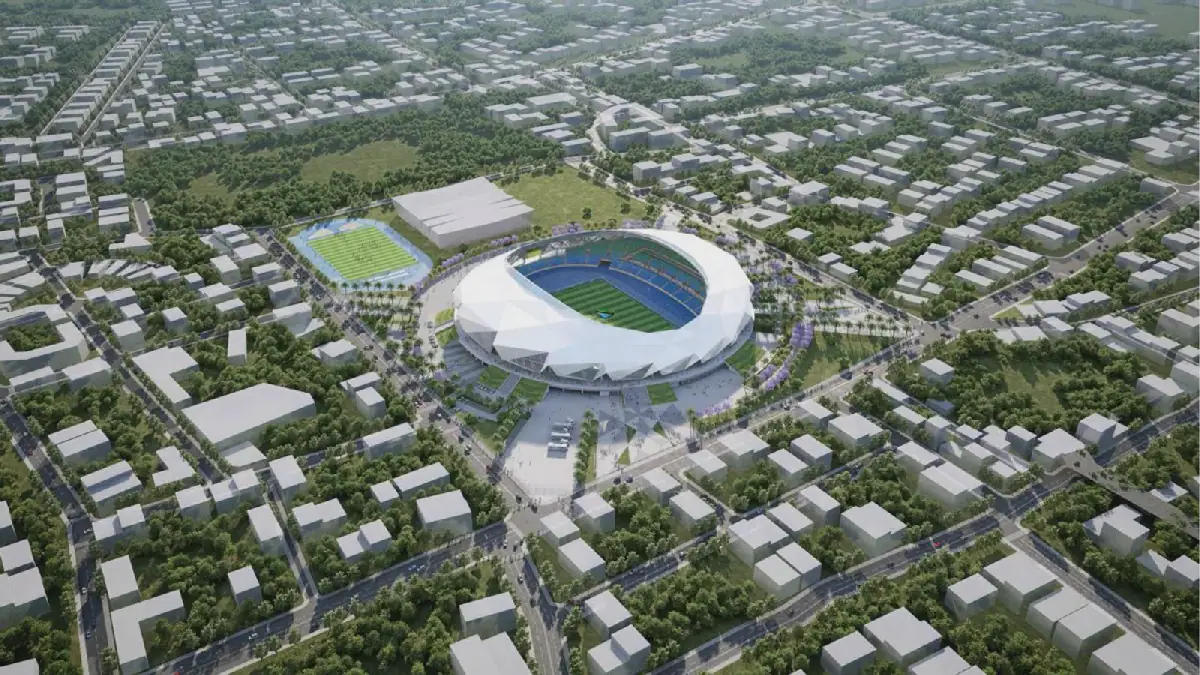
Tanzania, Kenya, and Uganda are investing heavily in modern sports infrastructure ahead of the 2027 Africa Cup of Nations (AFCON). The investments, which involve hundreds of millions of dollars, aim to strengthen East Africa's capacity to host major sporting events while creating lasting infrastructure for football development, sports tourism, and commercial activities. New stadiums are being built in Arusha, Zanzibar, Nairobi, Hoima, and Lira, alongside major upgrades to existing national facilities in Dar es Salaam, Nairobi, and Kampala.
Tanzania's AFCON 2027 infrastructure programme features three principal match venues: Samia Suluhu Hassan Stadium in Arusha, Benjamin Mkapa National Stadium in Dar es Salaam, and Fumba Stadium in Zanzibar. The projects combine new stadium construction with the modernisation of existing facilities, expanding the country's capacity to host international football competitions. The new Samia Suluhu Hassan Stadium in Olmoti, Arusha, represents one of Tanzania's largest investments in sports infrastructure, with a cost of 338.54bn/-, equivalent to approximately 128.2 million US dollars.
The Samia Suluhu Hassan Stadium project includes a planned seating capacity of approximately 32,500 spectators and is being developed as a modern sports complex with facilities designed to meet international competition requirements. The contract value increased from an original estimate of 187bn/- to 338.54bn, representing an 81 per cent increase. Permanent Secretary in the Ministry of Information, Culture, Arts and Sports, Gerson Msigwa, attributed the increase to changes in the project's scope and technical requirements following Tanzania's selection to co-host AFCON 2027.
The stadium's engineering design incorporates a reinforced-concrete structural frame, complemented by a sophisticated steel roof and facade system featuring trusses and a single-layer spatial grid. The roof structure uses approximately 7,762 tonnes of steel to provide extensive coverage over spectator areas. The facility also incorporates modern spectator seating, VIP and hospitality facilities, players' and officials' facilities, and technical installations.
In Dar es Salaam, the 60,000-capacity Benjamin Mkapa National Stadium is undergoing extensive rehabilitation to meet the technical and operational requirements of AFCON 2027. The government initially disclosed a rehabilitation programme valued at approximately 39bn/-, equivalent to US$14.7 million. A major component involved replacing all 60,000 spectator seats, which is estimated at 39bn/-. Other improvements have covered the playing surface, drainage, floodlighting, VVIP facilities, players' dressing rooms, media areas, sound systems, and supporting technical infrastructure.
The latest rehabilitation phase has placed particular emphasis on reconstructing the playing surface to improve drainage and meet international football standards, alongside improvements to hospitality, spectator movement, security, and backup power. In Zanzibar, Fumba Stadium is emerging as another major addition to Tanzania's sporting infrastructure. The new facility, being constructed by Turkish contractor Orkun Group, is designed to accommodate approximately 36,500 spectators, at a cost of about 400bn/-.
The Fumba Stadium project is part of the wider Zanzibar AFCON Sports Complex, which includes modern spectator facilities, covered seating areas, and supporting infrastructure. It also incorporates two additional outdoor football grounds, each with a seating capacity of 5,000 spectators, to support training and other sporting activities. The wider project includes improvements to access roads and other infrastructure intended to facilitate the movement of teams, spectators, and visitors while supporting Zanzibar's development goals.
Key points
- Tanzania, Kenya, and Uganda are investing heavily in modern sports infrastructure ahead of the 2027 Africa Cup of Nations.
- The investments aim to strengthen East Africa's capacity to host major sporting events while creating lasting infrastructure for football development, sports tourism, and commercial activities.
- The projects include new stadiums in Arusha, Zanzibar, Nairobi, Hoima, and Lira, alongside major upgrades to existing national facilities in Dar es Salaam, Nairobi, and Kampala.