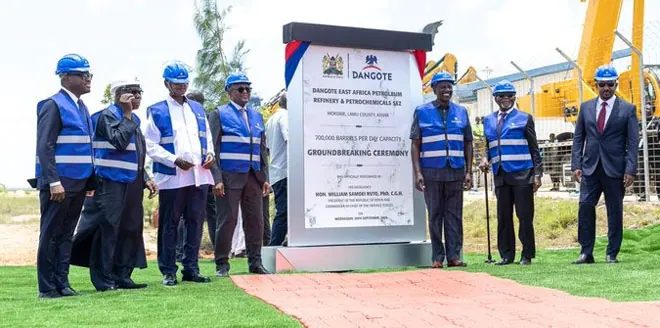
East Africa is on the verge of an oil refining boom, with several major projects underway in Kenya, Uganda, and Tanzania. The goal is to reduce the region's reliance on imported petroleum products. Kenya's Lamu refinery project, launched on September 30, is expected to process 700,000 barrels of crude oil per day and create around 60,000 jobs. The project, backed by Nigerian industrialist Aliko Dangote, aims to supply fuel to Kenya and other regional countries.
Kenya's Lamu project marks a return to large-scale refining in the country, following the closure of the Kenya Petroleum Refineries Limited facility in Mombasa in 2013. The new refinery will be much larger than the old one, with a significantly higher processing capacity. Afreximbank, which has invested heavily in African industrial projects, supports the Lamu refinery, citing its potential to strengthen regional energy security and retain more value from African crude on the continent.
Uganda is also planning a 60,000 barrel-a-day refinery at Hoima in its oil-producing Albertine region. The government has signed an agreement with UAE-based Alpha MBM Investments for the project, which is expected to produce petrol, diesel, LPG, kerosene, and jet fuel, as well as provide feedstock for petrochemical industries. Uganda's President Yoweri Museveni has emphasized the importance of having a domestic refinery to serve the local market and neighboring areas.
Tanzania is considering a separate refinery at Tanga, with technical work already underway, including feasibility studies and land requirements. The project could potentially process crude from Uganda and other regional producers. The plans represent a significant shift in how East African countries view their oil resources, with a focus on refining crude within the region to conserve foreign exchange and increase trade between African economies.
The emergence of several refineries raises questions about whether the region can support all of them, with concerns about competition for crude supplies and regional markets. However, governments have presented the projects as potentially complementary, with Uganda's domestic refinery securing part of its fuel supply and Tanzania's project serving a wider regional market. Kenya's Lamu refinery, with its larger market, could serve countries across East and Central Africa.
One of the biggest challenges for the refineries will be ensuring they have enough crude to operate efficiently. Uganda is moving towards commercial production, while South Sudan is already an oil producer. Kenya has oil resources but does not currently produce crude on a scale that could supply a refinery of Lamu's proposed size. The development of pipelines, storage terminals, ports, and roads will be crucial to connecting producers with refineries and linking refineries to consumers.
The projects have significant implications for African industrialization, with Afreximbank aiming to support the continent's move away from exporting raw materials and importing finished products. The bank has invested around $15bn in the Dangote Group since 2015, illustrating its commitment to this approach. The success of these refinery projects could serve as a test for African industrialization and regional economic integration.
Key points
- The Lamu refinery project in Kenya is expected to process 700,000 barrels of crude oil per day and create around 60,000 jobs.
- Uganda's planned refinery at Hoima will produce petrol, diesel, LPG, kerosene, and jet fuel, as well as provide feedstock for petrochemical industries.
- The refinery projects in East Africa aim to reduce the region's reliance on imported petroleum products and conserve foreign exchange.