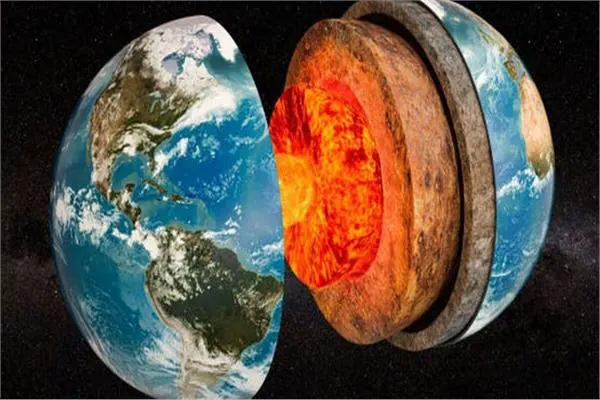
A recent scientific study has revealed that the Earth's day is not exactly 24 hours long, as previously thought. Researchers have found that the planet's rotation speed varies slightly, causing the length of a day to change. This phenomenon is attributed to the interactions between the Earth's core and mantle, which affect the planet's angular momentum. These changes are extremely small, but they provide valuable insights into the Earth's internal dynamics.
The Earth's rotation is not constant, and scientists have been monitoring these changes using precise measurements. The planet's rotation speed is influenced by the interactions between its internal layers, including the core and mantle. When the core's rotation speed increases, the mantle's rotation speed may decrease, and vice versa. This process is governed by the conservation of angular momentum, which dictates that changes in one part of the Earth system must be balanced by changes in another part.
Researchers have been studying the Earth's core and mantle interactions for nearly three decades, using data from the planet's magnetic field. The core's rotation speed can increase or decrease over several years or decades, causing corresponding changes in the mantle's rotation speed. These changes are reflected in the Earth's rotation period, which can vary by a few milliseconds. Understanding these interactions is crucial for gaining insights into the Earth's internal dynamics.
A recent study published in Nature on September 23 provides a possible explanation for the transfer of angular momentum between the core and mantle. The study suggests that gravitational forces play a key role in this process. The Earth's core is not a perfect sphere, and the mantle's mass distribution is not uniform, which can lead to the formation of a gravitational torque. This torque enables the transfer of angular momentum between the core and mantle, affecting the Earth's rotation speed.
In addition to gravitational forces, other forces such as friction and electromagnetic resistance also influence the Earth's internal dynamics. These forces can counteract the effects of gravitational torque, limiting large changes in the Earth's rotation speed. The interplay between these forces results in the small variations in the Earth's rotation period that scientists have observed.
The study's findings have significant implications for our understanding of the Earth's internal dynamics. The variations in the Earth's rotation period, although small, provide a unique window into the planet's internal processes. By studying these changes, scientists can gain insights into the Earth's core and mantle interactions, which are essential for understanding the planet's behavior.
The research also suggests that the Earth's core may undergo slow and viscous deformations over periods of up to a decade, which can affect the planet's rotation speed. These findings highlight the complexity of the Earth's internal dynamics and the need for continued research into the planet's behavior. By exploring these phenomena, scientists can refine their understanding of the Earth's internal processes and improve their ability to predict future changes.
Key points
- The Earth's rotation speed varies slightly due to interactions between the core and mantle.
- Gravitational forces play a key role in the transfer of angular momentum between the core and mantle.
- The study's findings provide new insights into the Earth's internal dynamics and the planet's behavior.