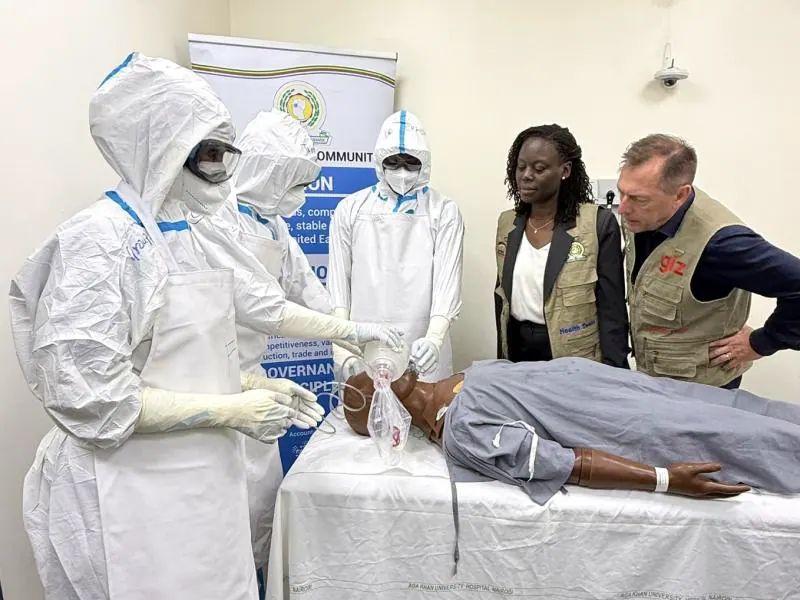
The East African Community (EAC) has initiated a training program for 120 health professionals from its eight member states, including the Democratic Republic of Congo. The training, which is taking place in Nairobi, Kenya, aims to strengthen the preparedness and response of frontline health workers to high-risk infectious diseases such as Ebola. The program, known as Training in the East African Community for High-Consequence Infectious Diseases (tEACH), is a collaboration between the EAC and the German International Cooperation Agency (GIZ).
The training program includes practical simulations covering case identification and isolation, infection prevention and control, safe use of personal protective equipment, sample collection, patient care, and emergency response. The EAC has also established a network of 10 mobile laboratories in seven partner states, providing rapid diagnostic capacity at strategic locations and entry points. These laboratories have been deployed in various locations, including Beni, Busia, and Bwera, and have supported responses to Ebola, Marburg, COVID-19, and Mpox.
The EAC has estimated that approximately $45 million is needed to effectively respond to the Ebola outbreak. To support these efforts, Germany has pledged an additional $4.8 million to enhance the EAC's preparedness and response to Ebola. This funding will facilitate the training of 500 frontline health workers, community sensitization of 15,000 people in eastern DRC, procurement of 20,000 personal protective equipment sets, and support for the registration of new Ebola vaccines in EAC partner states once approved by the World Health Organization (WHO).
The ongoing Ebola epidemic in the Democratic Republic of Congo has resulted in significant challenges, including a shortage of health personnel and resources. The EAC's training program aims to address these gaps by enhancing the skills and expertise of frontline health workers. The program also seeks to strengthen collaboration and coordination among EAC member states in responding to infectious disease outbreaks.
The EAC's efforts to combat Ebola are part of a broader strategy to enhance regional preparedness and response to infectious disease outbreaks. The community has established a range of initiatives, including the tEACH program, to support its member states in responding to public health emergencies. These initiatives have been critical in supporting responses to outbreaks, including Ebola, in the region.
The training program for 120 health professionals in Nairobi is a significant step towards enhancing the EAC's response to infectious disease outbreaks. With the support of Germany and other partners, the EAC is working to strengthen its capacity to respond to public health emergencies and protect the health and well-being of communities in the region.
Key points
- The EAC has launched a training program for 120 health professionals to enhance their response to infectious disease outbreaks, including the ongoing Ebola epidemic in the Democratic Republic of Congo.
- The EAC has estimated that approximately $45 million is needed to effectively respond to the Ebola outbreak.
- Germany has pledged an additional $4.8 million to support the EAC's preparedness and response to Ebola.