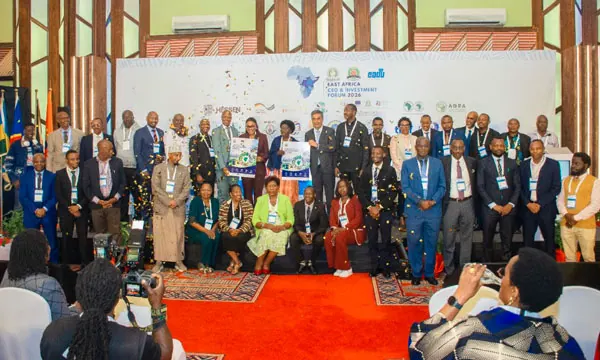
The East African Community (EAC) has launched a regional platform aimed at coordinating circular economy policies and attracting investment into waste management, recycling, and resource-efficient industries. The platform was launched by First Deputy Prime Minister and Minister for East African Community Affairs in Uganda, Rebecca Alitwala Kadaga, at the East Africa CEO & Investment Forum 2026 in Nairobi. This initiative seeks to bring together governments, companies, investors, civil society, academia, and other stakeholders to develop common approaches to circular economy and Extended Producer Responsibility (EPR) initiatives.
The launch of the platform comes as East Africa faces a growing waste-management challenge. According to a presentation by Gift Gabriel Mbuya of the East African Business Council, waste generation in the region increased to 180 million tonnes in 2023 from 90 million tonnes in 2010. Currently, only about 10% of the waste is recycled, while between 40% and 60% remains uncollected. These figures highlight both the scale of the environmental challenge and the potential for investment in recycling, waste collection, resource recovery, and other circular economy businesses.
The EAC member states have introduced measures to improve waste management; however, differences in policies and implementation have created a need for greater regional coordination and standardization. The platform will focus on policy harmonization, knowledge sharing, technical advice, and coordination of circular economy and EPR initiatives across EAC member states. It will provide a forum for producers, importers, brand owners, retailers, waste-management operators, and informal-sector representatives, as well as governments, regulators, civil society organizations, and universities.
The private sector has expressed its readiness to support practical solutions to the waste management challenge. Simon Kaheru, EABC Vice Chairperson, stated that the private sector is ready to move from dialogue to action, adding that the platform could help create jobs, promote social inclusion, and support more sustainable businesses. The platform will operate through four pillars: stakeholder policy dialogue, knowledge building and management, technical advisory services, and coordination.
The initiative will provide guidance on EPR frameworks, disseminate best practices and legal and practical information, and share information on potential financing mechanisms for circular economy projects. EPR schemes generally make producers and other businesses more responsible for managing products and packaging after they enter the market, creating incentives for collection, recycling, and reuse. Emmanuel Butare, an EABC Board Director, emphasized that resilient value chains and environmental, social, and governance priorities would be central to the region's transition.
The platform is expected to strengthen public-private dialogue while supporting regional markets, value chains, innovation, and investment in resource-efficient industries. Its inaugural members include the International Council of Business Associations (Africa Region), Coca-Cola Beverages Africa, Institute of Economic Affairs CIPARD, Eastern and Southern African Management Institute (ESAMI), Land Africa Safaris, AtoZ Group Ltd, Bela Wine, TakaTaka ni Mali, and Kagera Solutions. The EABC has called on governments, businesses, development partners, academia, and civil society to participate in the platform.
The EAC's initiative aims to turn growing waste volumes into opportunities for investment, innovation, and job creation. By coordinating circular economy policies and attracting investment, the region can address its waste management challenges while promoting sustainable businesses and economic growth. The platform's success will depend on the participation of various stakeholders, including governments, businesses, and civil society organizations, in supporting the transition to a more circular economy.
Key points
- The EAC has launched a regional platform to coordinate circular economy policies and attract investment into waste management, recycling, and resource-efficient industries.
- Waste generation in East Africa increased to 180 million tonnes in 2023 from 90 million tonnes in 2010, with only about 10% of the waste being recycled.
- The platform will focus on policy harmonization, knowledge sharing, technical advice, and coordination of circular economy and EPR initiatives across EAC member states.