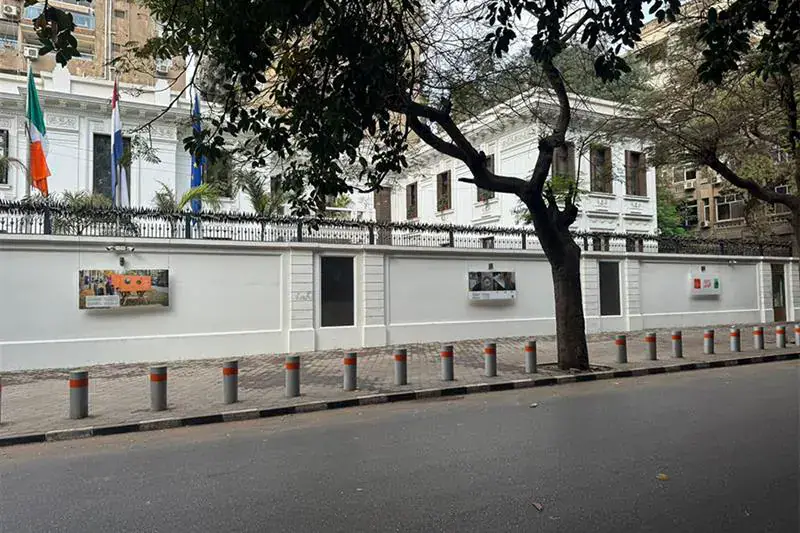
The Dutch Embassy in Cairo announced on Tuesday, 24 November, that it was closing its premises to the public until further notice. This decision was made by the Netherlands' Ministry of Foreign Affairs as a temporary precautionary measure due to demonstrations taking place in front of the building. The closure was part of the embassy's precautionary protocols and would remain in effect until a subsequent announcement on the resumption of public access.
The protests were sparked by the detention of Egyptian activist Ahmed Nasser, deputy head of the Egyptian Youth Union Abroad. Dozens of demonstrators gathered outside the embassy to condemn his detention and demand his immediate release. They also called for the expulsion of the Dutch ambassador to Cairo. The protesters raised banners with slogans accusing the Netherlands of "imprisoning honourable people while supporting terrorism."
The case dates back to 11 October, when Dutch authorities detained Nasser over his alleged involvement in an assault on Anas Habib, a former Egyptian citizen. Habib had filmed himself padlocking the gates of the Egyptian Embassy in The Hague. As a result, Habib and his brother Tarek had their Egyptian citizenship revoked by Cabinet decisions published in the Official Gazette on 12 November.
The Egyptian government has been actively engaged with the Dutch authorities over Nasser's detention. On 12 October, Foreign Minister Badr Abdelatty held a phone call with his Dutch counterpart, Tom Berendsen, in which he raised Nasser's arrest and urged his release. Abdelatty stressed the importance of ensuring protection for the Egyptian Embassy in The Hague in accordance with the Netherlands' obligations under the 1961 Vienna Convention on Diplomatic Relations.
The protests in Cairo also urged the Dutch authorities to protect the Egyptian Embassy in the Netherlands against provocations by members of the Muslim Brotherhood, which Egypt designates a terrorist group. The protesters demanded clarification of the circumstances of Nasser's detention and his swift release. The embassy advised anyone needing urgent assistance to call its emergency line.
The closure of the embassy did not affect the services provided by VFS Global in Cairo, which continued to operate independently. People with existing appointments were to be contacted as soon as possible to have them rescheduled. The Dutch Embassy's emergency line was made available for those in need of urgent assistance.
On 13 October, Tarek Radwan, chairman of the House of Representatives' Human Rights Committee, called on the Dutch authorities to clarify the circumstances surrounding Nasser's detention and to explain the legal basis for the measures taken against him. The developments eventually led to the closure of the embassy, highlighting the tensions between Egypt and the Netherlands over Nasser's detention.
Key points
- The Dutch Embassy in Cairo closed temporarily due to protests over the detention of Egyptian activist Ahmed Nasser.
- The protests were sparked by Nasser's detention and demanded his immediate release and the expulsion of the Dutch ambassador to Cairo.
- The Egyptian government has been actively engaged with the Dutch authorities over Nasser's detention, with Foreign Minister Badr Abdelatty raising the issue with his Dutch counterpart.
Reporting sources
- Dutch Embassy in Cairo Closes After Fresh Protests · Egyptian Streets