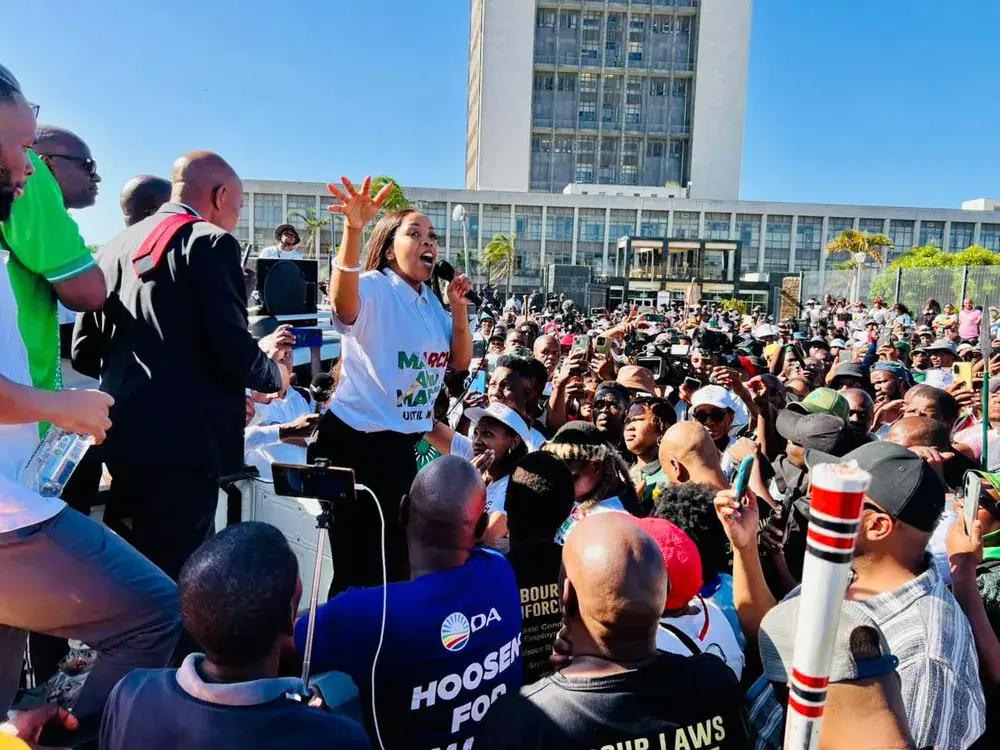
The Durban High Court has ruled that members of the March and March movement and others joining their anti-illegal immigration protests may not protest over the election period. When protests resume, they may only be held between 10am and 3pm, and along designated routes. The court also ordered that protesters may not carry weapons, obscure their faces, or engage in violent conduct. This decision was made in response to an application by Acting Police Minister Firoz Cachalia and KZN Police Commissioner Nhlanhla Mkhwanazi.
The March and March movement's attorney, Xolani Zuma, addressed supporters outside the court after the judgment was delivered. He stated that the movement would only resume its protests after November 6, in compliance with the court order. Zuma pleaded with supporters to resume protests from November 7, and to comply with the court order to avoid further legal action. The decision to ban sticks sparked unhappiness among marchers, who said they pride themselves in their Zulu accessories when expressing themselves.
March and March leader Jacinta Ngobese-Zuma intervened to calm the crowd, explaining that they were faced with a choice between marching without sticks or not marching at all. The court's decision comes after Cachalia and Mkhwanazi applied for an interdict barring the movement from marching in the Durban CBD and around the Home Affairs Refugee Reception Centre on Che Guevara Road. The police had cited concerns over public safety and potential violence.
Cachalia defended the police's court action against the March and March movement, saying protests held without notice place additional pressure on law enforcement and can lead to violence, arson, and loss of life. He stated that police were being forced to divert officers and resources at short notice to deal with demonstrations that could escalate into violent confrontations, while officers themselves were also being put at risk.
Cachalia highlighted the risks faced by police officers deployed to volatile situations, saying they were members of the same communities they were expected to protect. He emphasized that deploying large numbers of officers to KwaZulu-Natal came at a considerable cost to the police service, including transport, accommodation, protection, and overtime. The minister said the application was not about denying people their right to protest, but about asking the court to clarify the legal parameters within which demonstrations should take place.
The police had a responsibility to protect property and the safety of people in the country, while ensuring that officers could carry out their duties without being unnecessarily exposed to danger. Cachalia said the police needed the court's assistance to establish those boundaries and ensure that the right to demonstrate was not used to justify violence or criminality. The court's interdict aims to balance the right to protest with the need to maintain public safety.
The March and March movement will resume protests on November 7, with supporters expected to march without sticks or other prohibited items. The movement's leaders have urged supporters to comply with the court order and avoid any actions that could lead to further legal action. The Durban High Court's interdict is set to have a significant impact on the March and March movement's protests and the broader debate around public safety and the right to protest in South Africa.
Key points
- The Durban High Court has interdicted the March and March movement from protesting during the election period, citing concerns over public safety and potential violence.
- The court has ordered that protests may only be held between 10am and 3pm, and along designated routes, and that protesters may not carry weapons or obscure their faces.
- The March and March movement will resume protests on November 7, with supporters expected to march without sticks or other prohibited items.