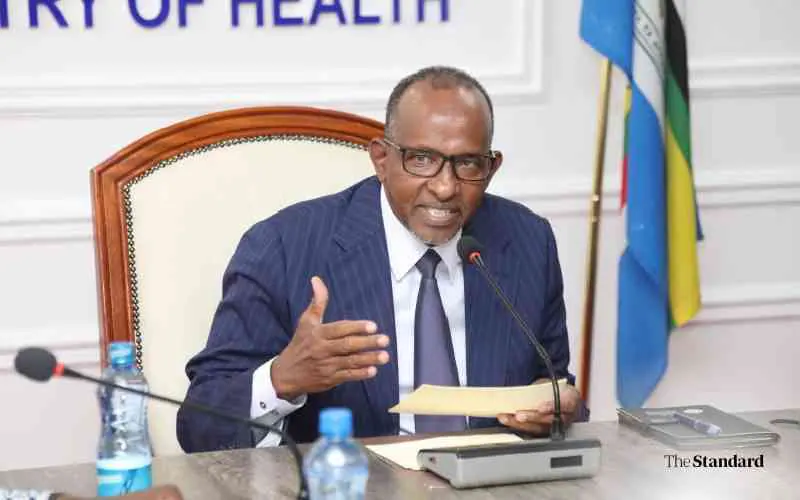
Health Cabinet Secretary Aden Duale has urged airlines, tourists, and businesses to maintain normal operations, assuring that Kenya remains safe for travel, tourism, and investment despite its first imported Ebola case. Duale made the remarks during a briefing for ambassadors and representatives of international organisations on Kenya's Ebola preparedness and response. He emphasised that restrictions on travel and trade could cause social and economic disruption without providing additional public health protection.
The briefing came after Kenya confirmed its first imported case of Bundibugyo Ebola Virus Disease (EBVD), with the patient dying after arriving in Nairobi from the Democratic Republic of Congo (DRC) through Uganda. The patient, a Kenyan citizen who had been living in the DRC, travelled by road to Kampala before flying to Nairobi on October 3. He was isolated after arriving at Jomo Kenyatta International Airport and later tested positive.
Duale explained that the confirmation of this imported case is a serious public health event, yet it does not, by itself, establish widespread transmission in the country. The government has identified 57 contacts linked to the case and is tracing those who have not yet been accounted for. Those already reached are under monitoring or quarantine. Kenya has intensified surveillance through national and county rapid response teams operating in 27 counties.
Kenya has also increased screening at 15 points of entry, with more than 652,000 travellers screened and 4,971 health workers trained on Ebola preparedness and response. The country has designated isolation, treatment, and quarantine facilities at Kenyatta National Hospital, Moi Teaching and Referral Hospital, National Police Service Hospital, Port Reitz Hospital, and The Nairobi Hospital. These facilities have a combined capacity of 241 beds.
The government has also mobilised infection prevention supplies and personal protective equipment (PPE) to protect frontline health workers. The World Health Organization (WHO) has provided 1,000 PPE sets, while India has donated 6,000 sets. President William Ruto directed authorities to intensify contact tracing and response operations after confirmation of the imported case.
Duale asked international partners to support field operations, logistics, commodity distribution, additional health workers, community engagement, patient referrals, and dedicated transport systems. The case is linked to the wider Bundibugyo virus disease outbreak in the DRC. WHO said Uganda ended its latest outbreak in August, and Kenya is the fourth country to confirm a case linked to the current outbreak.
WHO has not recommended travel or trade restrictions involving Kenya, Uganda, or the DRC based on the information available, while urging countries to maintain surveillance and other public health measures. Duale said Kenya would continue sharing verified information with the public, neighbouring countries, and international partners as the situation develops. "Our approach is clear: detect early, isolate safely, test rapidly, trace comprehensively and respond decisively," he said.
Key points
- Kenya's Health Cabinet Secretary Aden Duale assures that the country remains safe for travel, tourism, and investment despite its first imported Ebola case.
- The government has identified 57 contacts linked to the case and is tracing those who have not yet been accounted for.
- WHO has not recommended travel or trade restrictions involving Kenya, Uganda, or the DRC based on the information available.