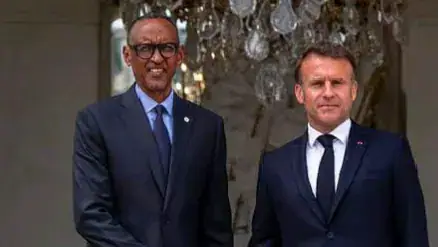
French President Emmanuel Macron has taken a significant step to prevent the Democratic Republic of Congo's potential withdrawal from the Organisation internationale de la francophonie (OIF). With the 20th Francophonie summit set to begin in Phnom Penh, Macron reportedly sent a message to Rwandan President Paul Kagame on November 12, requesting the withdrawal of Louise Mushikiwabo's candidacy for a third term as OIF Secretary-General. This move aims to avoid a potential crisis that could lead to the DRC's exit from the organization.
The DRC had previously expressed its opposition to Mushikiwabo's re-election, citing concerns over her ties to the Rwandan government. The Congolese government views Mushikiwabo as a loyal ally of President Kagame, who has been accused of supporting the M23 rebel group in eastern DRC. As a result, Kinshasa had vowed to take consequences if Mushikiwabo were re-elected. Macron's intervention comes as a surprise, especially given the close timing to the election, scheduled for November 16 in Phnom Penh.
According to sources, Macron's message indicated that DRC President Félix Tshisekedi and Mauritanian President Mohamed Ould Ghazouani would also withdraw their respective candidates, Juliana Lumumba and Coumba Ba. This would pave the way for Dacian Cioloș, a former Romanian Prime Minister, to become the next OIF Secretary-General. Cioloș is seen as a compromise candidate, with a focus on promoting a "francophonie utile" that emphasizes economic opportunities.
The DRC's potential exit from the OIF would be a significant blow to the organization, given its status as the second-largest French-speaking country in the world. With 57.3 million French speakers, the DRC accounts for a substantial portion of the OIF's membership. The organization's leadership is typically chosen by consensus, but in the absence of an agreement, the 53 member states may vote to elect a new Secretary-General.
Louise Mushikiwabo has been the OIF Secretary-General since 2018 and previously served as Rwanda's Foreign Minister from 2009 to 2018. Her candidacy has been met with resistance from the DRC, which has accused Rwanda of supporting rebel groups in eastern DRC. The OIF's leadership has traditionally been chosen by consensus, but this year's election has become increasingly contentious.
Macron's intervention may have shifted the dynamics of the election, with Cioloș emerging as the frontrunner. The Romanian candidate has pledged to prioritize African representation within the OIF, promising to appoint an African as the organization's second-in-command. This move aims to address concerns among African member states, which account for 26 of the OIF's 53 full member states and 65% of the world's French-speaking population.
The outcome of the OIF leadership election remains uncertain, with the possibility of a vote looming. If Louise Mushikiwabo's candidacy is withdrawn, the DRC would likely view it as a diplomatic victory. The situation highlights the complex relationships between Francophone countries and the challenges of maintaining consensus within the OIF.
Key points
- French President Emmanuel Macron urged Rwandan leader Paul Kagame to withdraw Louise Mushikiwabo's candidacy for a third term as OIF Secretary-General.
- The DRC had previously expressed opposition to Mushikiwabo's re-election due to concerns over her ties to the Rwandan government.
- Dacian Cioloș, a former Romanian Prime Minister, has emerged as the frontrunner to become the next OIF Secretary-General.