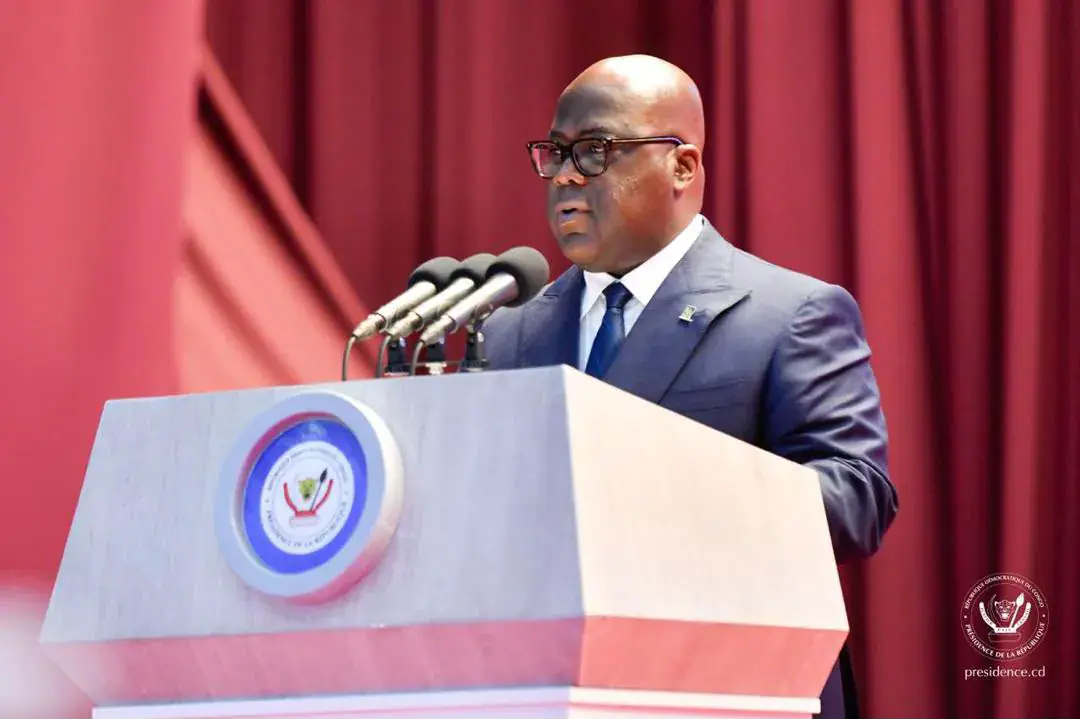
Democratic Republic of Congo President Félix Tshisekedi has rejected accusations of repressing the opposition following the arrest of Prince Epenge, leader of the ADDCongo party and spokesperson for the Lamuka platform. In a video message to the Congolese diaspora in Russia on October 30, Tshisekedi stated that being an opposition leader does not grant immunity from prosecution for spreading false information. He emphasized that opposition leaders must be held accountable for their actions.
Tshisekedi's comments come after Prince Epenge's arrest on October 25 at N'djili airport, where he was detained by unidentified individuals before traveling to Rome for a meeting with the Coalition article 64 (C64). Epenge's party claims his arrest was a "political kidnapping" and demanded his immediate release. The opposition figure is accused of spreading false rumors regarding the death of Manassé Lomboto, an ADDCongo militant.
According to Tshisekedi, Epenge's arrest is linked to his alleged role in spreading misinformation about Lomboto's death. The President claims that Lomboto died from illness, not as a result of violence during the September 15 demonstration, as the opposition had suggested. Tshisekedi argues that the opposition attempted to manipulate public opinion by falsely attributing Lomboto's death to the government's actions.
The Congolese President also criticized the current state of the opposition, describing it as weak. He contrasted this with the opposition efforts of his party, the UDPS, under the leadership of his father, Étienne Tshisekedi. Tshisekedi emphasized that his party's opposition was rooted in patriotism and did not involve violence or armed struggle.
Tshisekedi's remarks have sparked further debate amid heightened tensions between the government and the opposition. Several opposition actors have denounced what they see as the instrumentalization of justice against critical voices, while the authorities maintain that the procedure against Epenge is solely aimed at uncovering the truth about Lomboto's death.
The incident has also drawn reactions from other opposition leaders, including Martin Fayulu, who denounced a "two-speed justice system." Epenge's party has called for his immediate release, accusing the government of targeting opposition voices. The situation remains tense as the Congolese government and opposition continue to exchange accusations.
The controversy surrounding Epenge's arrest and Tshisekedi's response highlights the ongoing challenges in the DRC's democratic process. The incident raises concerns about the protection of opposition voices and the role of the judiciary in addressing allegations of repression. As the situation unfolds, the international community is watching closely, emphasizing the need for transparency and respect for human rights.
Key points
- The DRC President rejects claims of opposition repression amid Prince Epenge's arrest.
- Prince Epenge was arrested for allegedly spreading false information about the death of a militant.
- Tshisekedi criticizes the opposition as weak and emphasizes his party's patriotic opposition efforts.