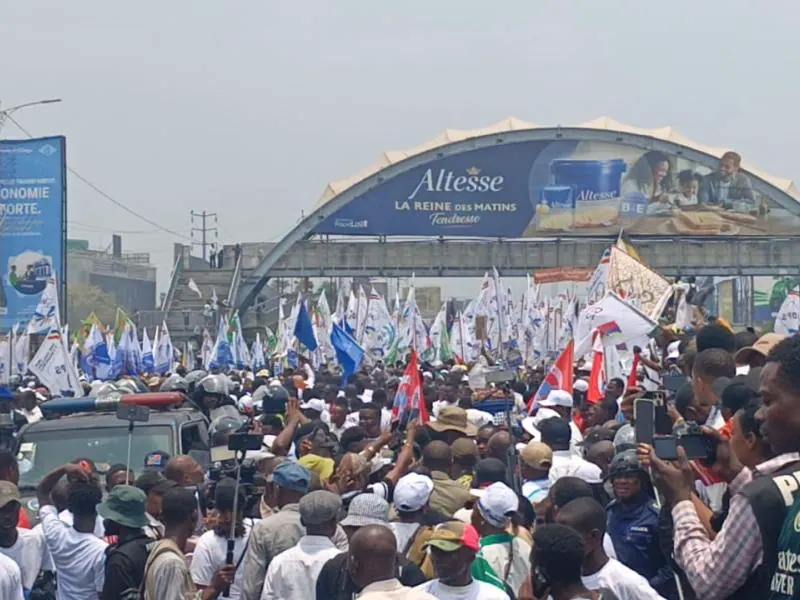
On September 22, 2026, the Union for Democracy and Social Progress (UDPS) and its allies organized a peaceful march in Kinshasa, Democratic Republic of the Congo. The march was secured by police, prompting criticism from opposition leaders who claim the government is applying a double standard. Delly Sesanga, president of Envol, expressed concern over the differential treatment of protests, questioning the government's commitment to democracy.
Sesanga wrote that when the opposition is denied access to the streets, but the ruling party is allowed to march, democracy becomes an empty discourse. He reaffirmed his opposition to any changes to the Constitution, a third term for President Félix Tshisekedi, and any extension of his term beyond 2028. Sesanga emphasized that popular mobilization must continue peacefully and through the ballot box.
Jean-Marc Kabund, a figure in the Coalition Article 64 (C64) for the defense of constitutional order, also criticized the government's double standard. He compared the C64's September 15 march, which was restricted, to the UDPS's September 22 march, which was secured by police. Kabund stated that the C64 will continue to fight for constitutional order and public freedoms.
The UDPS march drew thousands of supporters and high-ranking officials, including Augustin Kabuya, Christophe Mboso, and Taupin Kabongo Mukengeshay. The march aimed to show support for President Tshisekedi and the institutions in place, while defending the project to modify the Constitution and organize a popular referendum.
The comparison between the two marches comes after the C64 denounced restrictions and incidents during their September 15 mobilization in Kinshasa. The opposition leaders' criticism highlights concerns about the government's commitment to democracy and public freedoms in the DRC.
The UDPS and its allies have been vocal about their support for President Tshisekedi and the institutions in place. The party's march was seen as a show of strength and a demonstration of its influence in the country. However, the opposition leaders' criticism has sparked a debate about the government's handling of protests and the state of democracy in the DRC.
The situation highlights the ongoing challenges to democracy and public freedoms in the DRC. The government's response to protests and the opposition's criticism will likely continue to be a contentious issue in the country.
Key points
- DRC opposition leaders criticize government's double standard on protests
- Government's handling of protests sparks concerns about democracy and public freedoms
- Opposition leaders reaffirm commitment to peaceful mobilization and constitutional order