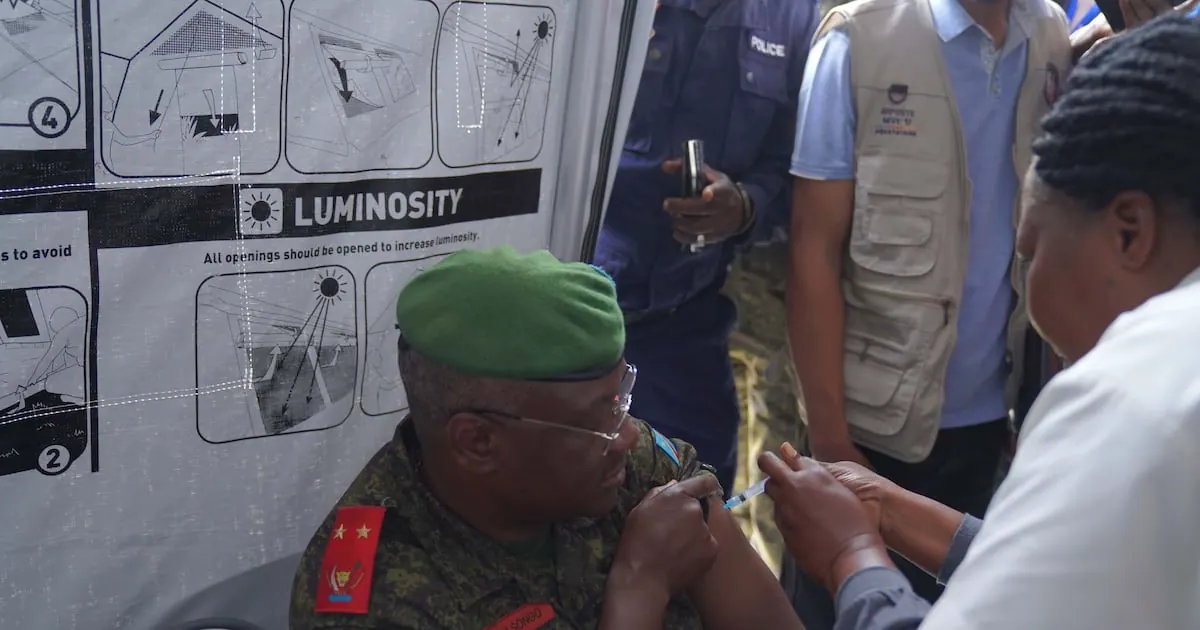
The Democratic Republic of the Congo has begun vaccinating health-care staff against Ebola in Bunia, the epicentre of the fastest-growing outbreak of the disease in history. The vaccination drive, launched on Saturday, targets health workers and other frontline workers in the Ebola response who are considered particularly exposed and deeply involved in the response. According to the provincial governor, Maj-Gen Gaby Kasongo Mulumba, the campaign aims to protect life by vaccinating those at high risk.
The rollout is focusing on the Bunia and Mongbwalu zones in Ituri province, which are among the hardest hit by the virus. The Ervebo vaccine, effective in past Ebola outbreaks caused by a different type of virus, is being used under a compassionate-use programme. Clinical trials are ongoing to find a licensed vaccine for the current outbreak, caused by the Bundibugyo virus, which has no licensed vaccine or treatment. Health authorities expect to cover 20,000 frontline workers over a period of six to nine months.
The outbreak in Ituri and North Kivu provinces has recorded 7,541 confirmed cases, including 3,639 deaths, according to government figures. A total of 1,823 people have recovered so far. The World Health Organisation has warned that the outbreak is out of control and on track to surpass the 2014-2016 West Africa Ebola outbreak, which killed over 11,000 people. The current outbreak is considered the deadliest of all past 17 Ebola outbreaks in the country.
Health workers have expressed mixed views about the vaccination. Dr Jeannot Elua, a health worker at a facility in Bunia, said the vaccine was beneficial and that he had already received it. In contrast, Dr Jean Paul Uzele, who was vaccinated with Ervebo during a previous outbreak, questioned whether he needed to be vaccinated again. The use of Ervebo is taking place in a specific scientific context, as it is licensed for use against Ebola virus disease caused by the Zaire strain.
The World Health Organisation has approved 70,000 doses of Ervebo for use in the DRC, with 50,000 doses intended for frontline and health workers. The remaining 20,000 doses will be used in a clinical trial to study whether the vaccine protects against Bundibugyo virus. Health authorities believe that Ervebo could offer some protection against the Bundibugyo virus, as the two viruses are related.
The vaccination campaign is taking place under challenging conditions, with insecurity, displacement, a health workers' strike, and intense population movements fuelling the spread of the disease. The DRC government, along with international health organisations, is working to contain the outbreak and prevent further spread. The situation remains critical, with the outbreak concentrated in Ituri province.
The DRC has previously used Ervebo in Kisangani, in the Tshopo province, where the campaign was expected to cover 14 health zones. The current vaccination drive aims to build on this experience and protect frontline workers from the Bundibugyo virus.
Key points
- The DRC has launched a vaccination campaign against Ebola in Bunia, targeting 20,000 health workers.
- The Ervebo vaccine is being used under a compassionate-use programme, as it is not specifically approved for the current outbreak.
- The outbreak in the DRC has recorded 7,541 confirmed cases and 3,639 deaths.