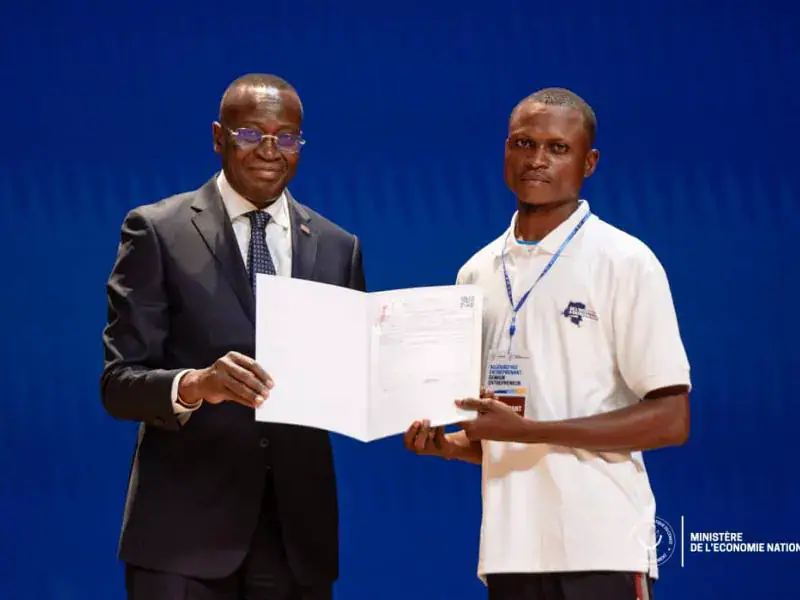
The Democratic Republic of Congo has begun a new phase in formalizing its informal economy. Prime Minister Judith Suminwa Tuluka and several government officials attended a ceremony in Kinshasa's financial center to distribute the first E1 activity certificates and entrepreneur cards to nearly 2,000 beneficiaries. This move follows a large-scale identification operation that registered over 200,000 economic actors. The certificates mark the start of their administrative recognition and pave the way for their gradual integration into the formal economy.
The formalization process aims to recognize the contribution of millions of Congolese people who participate in wealth creation, often outside the formal economy. Vice Prime Minister and Minister of National Economy Daniel Mukoko Samba emphasized that formalization goes beyond issuing administrative documents. He noted that the Congolese economy relies not only on mining resources like copper and cobalt but also on markets, small businesses, and supply chains that feed large cities.
The government intends to give administrative existence to these actors, improve their visibility, and create conditions for their structuring and development. Mukoko Samba highlighted the essential role of small entrepreneurs, such as traders who travel long distances to supply urban centers, in the functioning of the national economy. The formalization process is a key aspect of the government's strategy to promote an inclusive and structured economy.
Prime Minister Judith Suminwa Tuluka reaffirmed the government's commitment to accompanying this dynamic, presented as a declination of the head of state's vision for a more inclusive economy. She insisted that formalization should not be seen as a new administrative constraint but rather as an opportunity for recognition and support. The goal is to enable the state to better understand economic actors, officially recognize their activities, and establish mechanisms adapted to their needs.
The program also aims to provide a support pathway to strengthen the capacities and development prospects of small economic actors. The gradual articulation between formalization and universal health coverage is one of the axes of this approach. This should help expand access to social protection mechanisms for entrepreneurs in a sector where many workers remain outside classical devices.
The distribution of these first documents represents an important milestone in the Congolese economy's formalization policy. However, the challenge lies in consolidating this first progress, particularly through effective support for beneficiaries and the establishment of measures responding to the realities of the informal sector. The government aims to transform this administrative recognition into genuine economic and social opportunities.
The ultimate goal is to enable small entrepreneurs to develop their activities sustainably and contribute more to growth and job creation in the DRC. The government will need to ensure that this formalization process leads to tangible benefits for the beneficiaries and contributes to the country's economic and social development.
Key points
- The DRC government has issued E1 certificates to over 200,000 identified economic actors in the informal sector.
- The formalization process aims to recognize the contribution of millions of Congolese people to wealth creation.
- The government plans to provide support pathways to strengthen the capacities and development prospects of small economic actors.