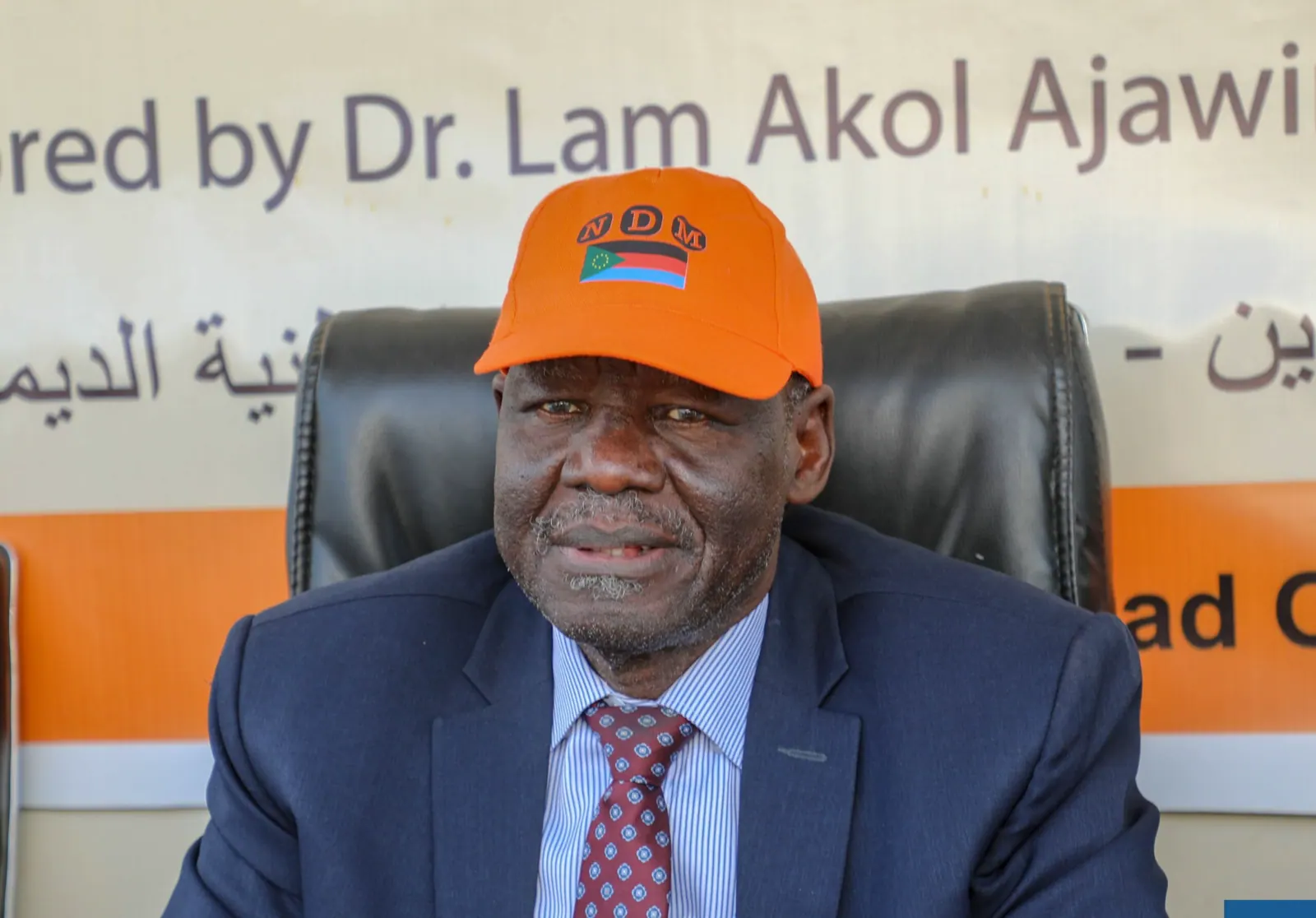
The leader of the National Democratic Movement (NDM), Dr. Lam Akol Ajawin, has warned that holding unilateral elections in South Sudan would lead to an illegitimate government and increased political chaos. Speaking at a public dialogue hosted by the South Sudan Network for Democracy and Elections (SSUNDE) on September 23, Dr. Lam emphasized that skipping key provisions of the 2018 peace deal would deprive citizens of their voting rights and undermine the mandate of any resulting administration.
Dr. Lam highlighted that state authorities are rushing to meet a polling deadline by shortening statutory timelines, neglecting security reforms, and restricting civic space. He stressed that a government elected without popular participation cannot claim legitimacy among the South Sudanese people. According to Dr. Lam, the 2018 peace deal aimed to establish sustainable peace and transition the nation into a democracy, but signatories have failed to accomplish either task over the last eight years due to a persistent lack of trust and dialogue.
The opposition leader accused the ruling SPLM-IG of using a military-style "war of attrition" to exhaust political opposition. He stated that the ruling party delays key processes until opposition groups either submit to its terms or abandon the peace deal entirely. This strategy of delay has stalled crucial institutional reforms across the country, including security sector transformation and the establishment of the Constitutional Court, which the peace deal mandated within eleven months of signing.
Dr. Lam also pointed out that parliament recently amended the Electoral Act, cutting the voter register display period from six months to three, reducing the campaign period from sixty days to forty-five, and shortening candidate nominations to fifteen days. These compressed windows create severe hurdles for gathering endorsement signatures across regions with limited transport infrastructure. Furthermore, the amendments require independent candidates to resign from their positions before voter registration lists are finalized.
The opposition leader outlined operational hazards facing the National Elections Commission (NEC), including questions about its neutrality and technical demands. He rejected claims that South Sudan can run partial elections by excluding unstable regions, noting that such practices belong to parliamentary systems like Sudan or Ethiopia. Because South Sudan operates under a presidential system, candidates require nationwide participation, which is currently hindered by widespread instability.
Dr. Lam presented two potential outcomes for the country as the election date approaches. In the first scenario, funding shortages, severe time constraints, and rampant insecurity prevent the NEC from conducting polls on time. In the second scenario, authorities force a unilateral election in limited pockets of the country, which Dr. Lam challenged as invalid, asking what the next course of action would be after having dissolved and obligated everyone.
Dr. Lam dismissed arguments that elections can proceed separately from the national census and constitution-making process, emphasizing that true legitimacy comes from South Sudanese voters rather than international bodies. If citizens cannot vote safely and freely, any resulting government lacks authority. With 88 days left before the election, Dr. Lam's warnings highlight the pressing challenges facing South Sudan's electoral process and the need for a more inclusive and legitimate process.
Key points
- Dr. Lam Akol warns that unilateral elections in South Sudan would produce an illegitimate government.
- The 2018 peace deal aimed to establish sustainable peace and transition the nation into a democracy but has not been fully implemented.
- Dr. Lam Akol emphasizes that true legitimacy comes from South Sudanese voters, not international bodies.