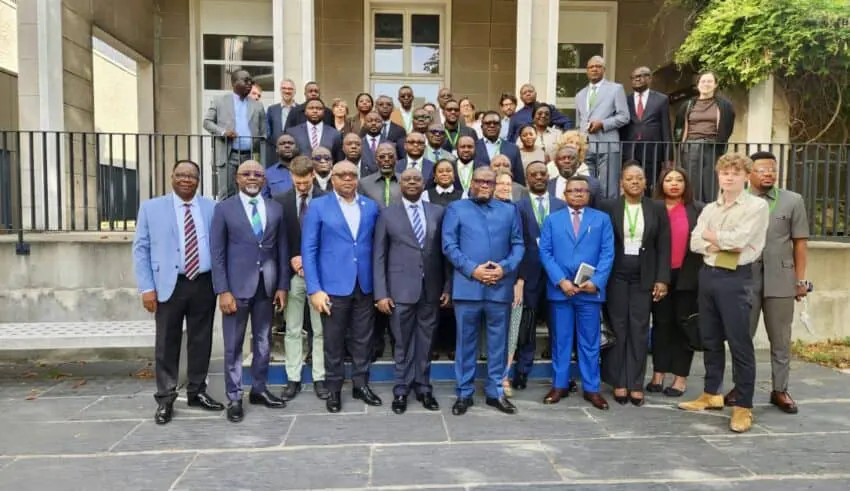
The Democratic Republic of Congo actively participated in a recent international conference in Paris focused on taxation and natural resource management in the Congo Basin. The event, organized by the Paris School of Economics and the Centre d’amitié Suisse-RDC, with support from One Forest Vision, took place from September 14-18, 2026, at the Paris School of Economics. Christophe Bitasiwma Bahii, Inspector General of Finance and head of the Inspection Générale des Finances (IGF), presented the country's mechanisms for securing public revenues from natural resource exploitation.
The conference brought together academic experts, policymakers, and public management professionals to examine challenges related to taxation, natural resource valuation, and governance in the Congo Basin. The DR Congo was represented by several public institutions and specialized structures, including the IGF, Société nationale d’électricité (SNEL), Direction générale des impôts (DGI), and others. These institutions showcased their efforts to address issues related to revenue mobilization and public finance management.
During the conference, Christophe Bitasiwma Bahii highlighted the actions taken by the IGF to combat financial delinquency and protect revenues generated from natural resources. His presentation focused on the evolution of public finance control methods, emphasizing a data-driven approach, risk targeting, and anticipation of irregularities. This approach aims to contribute to more effective public governance and ensure that the state's natural resources are transformed into revenues that benefit the population.
A key aspect of Bitasiwma's presentation was the need for a comprehensive approach to securing revenues, covering the entire value chain from resource production to revenue collection. This approach seeks to reduce revenue leakage, improve transaction traceability, and enhance public revenue mobilization. In the extractive sector, control issues extend beyond mineral extraction to commercialization, export, and valuation of produced substances.
The IGF emphasized the importance of monitoring the entire mining chain, including payment of fiscal obligations and repatriation of revenues. Each stage presents risks that can affect operation transparency and the budgetary yield of mining activities. The IGF's surveillance efforts aim to identify discrepancies and strengthen control mechanisms, ensuring that revenues generated from natural resource exploitation correspond to revenues legally due to public finances.
One of the key areas discussed at the conference was the use of cross-referenced data from different public administrations. According to the IGF's approach, discrepancies between technical, fiscal, customs, and financial data can help identify risks of public revenue loss. Cross-referencing these data aims to improve control accuracy and facilitate anomaly detection in natural resource-related operations.
The Paris conference provided a platform for public institutions, academia, and specialized actors to discuss ways to strengthen taxation and better valorize Congo Basin resources. The DR Congo's participation highlighted challenges related to revenue securitization, institutional coordination, and public management tool improvement. The closure of these discussions paves the way for further reflection on mechanisms to enhance operation transparency and natural resource contribution to development financing.
Key points
- DR Congo showcases its systemic control of public revenues at a Paris conference on taxation and natural resource management.
- The IGF emphasizes a data-driven approach to public finance control, targeting risks and anticipating irregularities.
- Cross-referencing data from public administrations can help identify revenue loss risks and improve control accuracy.