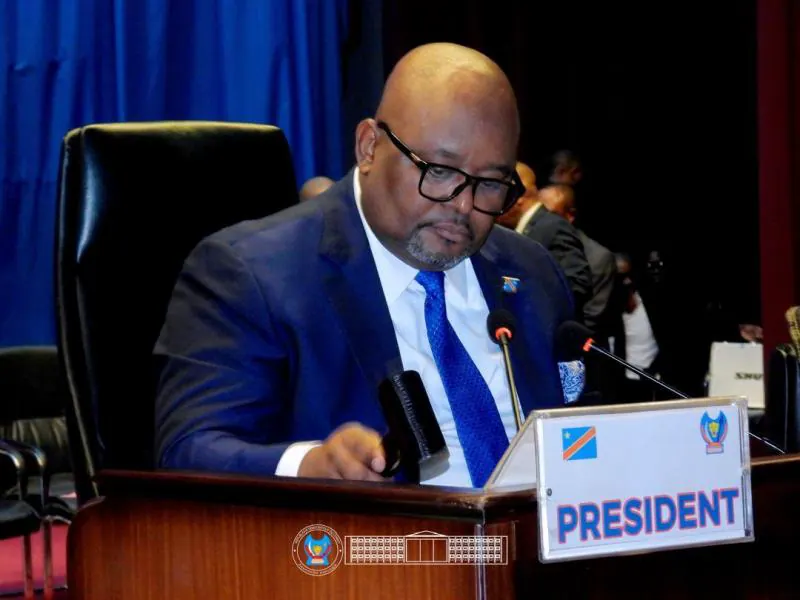
On October 8, 2026, Aimé Boji Sangara, the President of the National Assembly of the Democratic Republic of the Congo, addressed a plenary session to clarify an initiative aimed at tracking the achievements of deputies in their respective constituencies. The initiative seeks to inventory projects executed by national deputies using their own funds, which are not covered by the state. This move comes after a communiqué from the rapporteur of the lower house of parliament requested deputies to provide information on their achievements, including photos, videos, and project costs.
According to Boji Sangara, the primary objective of this initiative is to identify health centers and schools constructed or rehabilitated by deputies using their own funds, but which are not yet supported by the state. This includes mechanization and personnel costs in the health and education sectors. He emphasized that this initiative does not aim to undermine the constitutional missions of national deputies but rather to acknowledge and encourage those who undertake various social actions in favor of their constituents.
Boji Sangara praised deputies who intervene in favor of their constituents through various social actions, such as covering health expenses, funeral costs, and educational fees. He noted that these actions are often necessary due to the realities faced by populations in several constituencies. The President of the National Assembly emphasized that deputies sometimes go beyond their constitutional missions to respond to the needs of their constituents.
The initiative has sparked mixed reactions within the National Assembly, with divergent views between the majority and opposition. Gratien Iracan de Saint-Nicolas, an opposition deputy, disputes the principle of evaluating parliamentarians based on infrastructure or social works realized in their constituencies. He argues that constructing schools, roads, and health centers primarily falls under the executive's responsibilities and advocates for an evaluation based on legislative work and government oversight.
In contrast, Alexandre Kambale Muhasa, a majority deputy, believes that documenting achievements can be justified given the realities on the ground. He notes that deputies are often solicited by their constituents and may intervene using their own means when expected government responses are delayed. Kambale Muhasa clarifies that submitting photos and videos is not a new constitutional obligation, and no sanctions will be imposed for non-compliance.
The debate centers on distinguishing between the constitutional missions of national deputies and individual interventions they claim to undertake for the benefit of their constituents. Boji Sangara's clarification aims to establish an inventory of actions taken by deputies, particularly those requiring subsequent state support in the health and education sectors.
The controversy highlights the complexities of the role of deputies in the Democratic Republic of the Congo, where they are often expected to address social needs beyond their legislative duties. The initiative's success and its implications for the relationship between deputies, their constituents, and the state remain to be seen.
Key points
- The initiative aims to track and inventory projects executed by national deputies using their own funds.
- The move has sparked debate on the role and responsibilities of deputies in the Democratic Republic of the Congo.
- The initiative seeks to encourage deputies who undertake social actions in favor of their constituents.