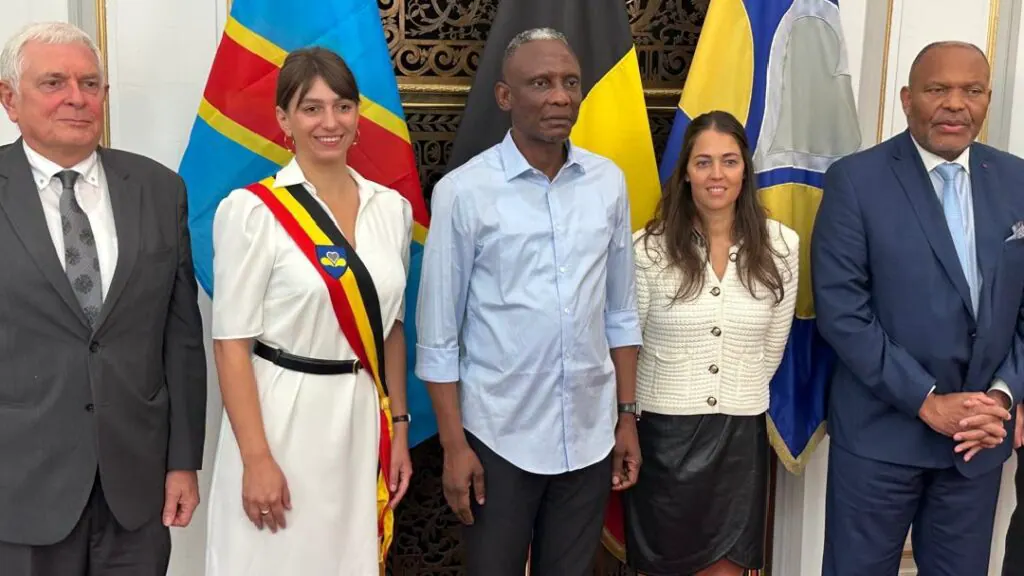
On September 25, Democratic Republic of the Congo's Infrastructure and Public Works Minister, John Banza, addressed the Brussels Parliament, urging Belgian lawmakers to reconsider their country's relationship with the DR Congo. He emphasized the importance of investing in the DR Congo, presenting progress made in various sectors, and advocating for a stronger partnership between the two nations. Banza's visit aimed to reposition the relationship between the DR Congo and Belgium, with infrastructure and investments as key drivers.
Banza highlighted the historical ties between the two countries, dating back to the era of King Leopold II, and stressed that the DR Congo is modernizing and building new infrastructure. He encouraged Belgian entrepreneurs to invest in the country, citing opportunities in various sectors. The minister's presentation was well-received by the Brussels Parliament, with President Bertin Mampaka, a Belgo-Congolese, expressing support for strengthening economic relations between the two nations.
Mampaka emphasized the need for a closer economic relationship between Belgium and the DR Congo, citing the presence of investors from India, Pakistan, Turkey, and China in the country. He believed that the shared history between the two nations could serve as a foundation for stronger economic collaborations. Mampaka also highlighted the human connections between the two societies, suggesting that Brussels could serve as a hub for Congolese actors seeking to strengthen ties with Europe.
The Brussels Parliament has announced plans for an upcoming economic mission to Kinshasa, scheduled for January 2027, with several Belgian companies participating, particularly in the infrastructure sector. This mission aims to match the DR Congo's needs with the capabilities of Belgian enterprises. According to a Brussels parliamentarian, the objective is to bring together the expectations of both parties with top-tier companies that will be selected for the mission.
Banza placed his efforts within the context of regional and international competition for influence, citing Chinese investments in the central corridor and US involvement in the Lobito corridor. He called on Europe, particularly Belgium, to strengthen its presence in Congolese projects. On the ground, the minister highlighted a program to build 28,800 kilometers of roads, aiming to reconnect the network inherited from the colonial era and link internal corridors to major regional corridors.
The DR Congo's infrastructure program is currently underway in all 26 provinces, with multiple projects in progress. Banza mentioned four airport platforms under construction, including Kinshasa, Lubumbashi, Bunia, and Kananga, as well as a program for 15 airports, with around 10 expected to be completed within the next two to three years. He also cited the construction of new university infrastructure, with six already built and a goal of reaching 20 universities, accompanied by student cities.
Banza views Belgium as a strategic partner, particularly in infrastructure, and believes that Belgian expertise can support projects in the DR Congo. He encouraged Belgian investors to look beyond concerns about the country's environment, stating, "We don't have a paradise, but we don't have a hell either." The minister's efforts aim to make the DR Congo a priority for Belgian entrepreneurs and companies.
Key points
- DR Congo's Infrastructure Minister John Banza seeks to attract Belgian investment in his country's reconstruction efforts.
- The two countries aim to strengthen economic ties, with a focus on infrastructure and investments.
- A Brussels parliamentary delegation plans to visit Kinshasa in January 2027 to explore investment opportunities.