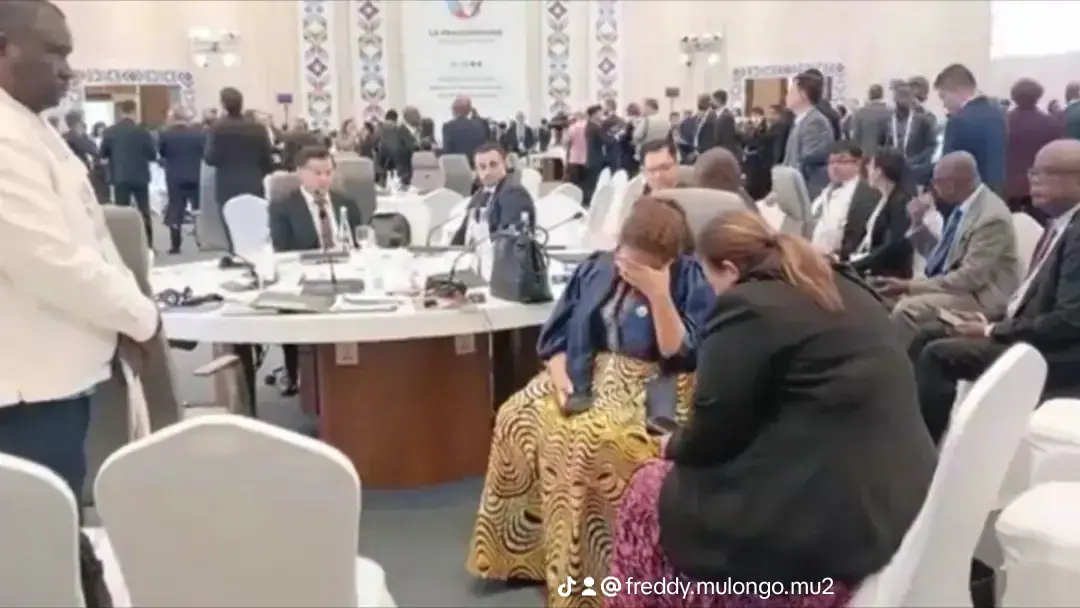
The Democratic Republic of Congo is embroiled in a diplomatic row with the International Organization of La Francophonie (OIF) over the reappointment of Louise Mushikiwabo as Secretary General. According to reports, Congolese President Félix Tshisekedi's administration has threatened to withdraw from the organization if Mushikiwabo, a Rwandan national and former Foreign Minister, continues in her position. The move has sparked controversy, with many questioning the legitimacy of the Congolese government's actions.
The OIF, a French-speaking international organization, has a history of navigating complex diplomatic relationships among its member states. In this case, the Congolese government's opposition to Mushikiwabo's candidacy has raised concerns about the country's commitment to multilateralism. Observers note that the OIF has a precedent for allowing its Secretary General to serve multiple terms, citing the example of Abdou Diouf, who served three consecutive terms.
The diplomatic tensions between the DR Congo and OIF have escalated, with Congolese Foreign Minister Thérèse Kayikwamba Wagner reportedly threatening to withdraw from 25 international and regional institutions. Wagner, a close collaborator of President Tshisekedi, has been at the center of the diplomatic efforts to address the OIF candidacy issue. Her actions have sparked debate about the country's diplomatic strategy and its implications for regional relationships.
The controversy surrounding Mushikiwabo's reappointment has also raised questions about the DR Congo's commitment to the Francophonie. The country's potential withdrawal from the organization could have significant implications for its relationships with other French-speaking countries and its participation in international forums. Moreover, the DR Congo's actions have been criticized as a " bluff" by some observers, who argue that the country's threats are not credible.
The DR Congo's diplomatic row with the OIF has also sparked concerns about the country's isolation on the international stage. The country's potential withdrawal from the organization could be seen as a repeat of the Morocco's decision to leave the Organization of African Unity (OAU) in 1984. Morocco returned to the African Union in 2017, after a 32-year absence, following a favorable vote by 39 member states.
Critics of the Congolese government's actions argue that the country's diplomatic strategy is driven by domestic politics rather than a genuine concern for the OIF's leadership. They point out that President Tshisekedi's administration has been criticized for its authoritarian tendencies and that the OIF candidacy issue is being used as a distraction from domestic issues. The controversy has also sparked debate about the role of the Francophonie in promoting democracy and human rights in Africa.
The diplomatic row between the DR Congo and OIF has significant implications for regional relationships and the country's international reputation. As the situation continues to unfold, it remains to be seen how the DR Congo will navigate its relationships with other French-speaking countries and international organizations. One thing is certain, however: the country's actions will have far-reaching consequences for its diplomatic relationships and its participation in international forums.
Key points
- The DR Congo's diplomatic row with the OIF has sparked concerns about the country's commitment to multilateralism and its implications for regional relationships.
- The controversy surrounding Louise Mushikiwabo's reappointment as OIF Secretary General has raised questions about the DR Congo's diplomatic strategy and its implications for international relationships.
- The DR Congo's potential withdrawal from the OIF could have significant implications for its relationships with other French-speaking countries and its participation in international forums.