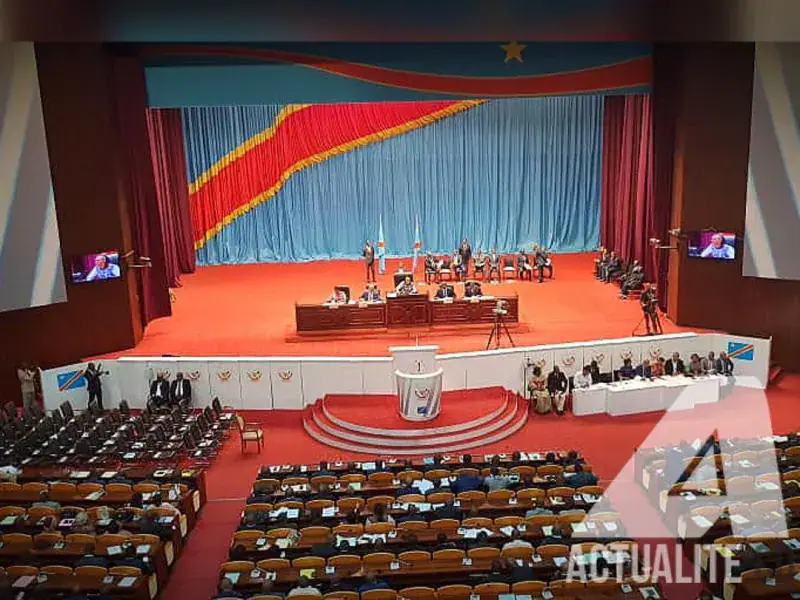
The National Assembly of the Democratic Republic of the Congo has declared the bill on the accountability of the 2025 financial law admissible. This development occurred during a plenary session on October 28, 2026, after the bill was presented by Finance Minister Doudou Fwamba Likunde. The bill's admissibility was approved without a general debate following a procedural motion by Deputy Patrick Matata.
The bill, which concerns the accountability of the 2025 financial law, was declared admissible after the Lower House received observations from the Court of Accounts regarding the project. The bill was subsequently sent to the Economic, Financial and Budget Control Commission for in-depth examination. The Commission has been given a seven-day deadline to present its report. According to the Assembly's President, Aimé Boji Sangara, the Commission's bureau must take necessary measures to meet this deadline.
Minister Doudou Fwamba presented the context that characterized the 2025 budget year, marked by significant challenges. These challenges included the loss of a substantial portion of revenues due to the occupation of Goma and Bukavu cities by the AFC/M23 rebellion, supported by Rwanda. Additionally, there was a reduction or suspension of support from international donors.
Despite these challenges, the execution of the 2025 budget demonstrated a remarkable performance of public finances. According to Minister Fwamba, the budget report shows that out of a forecast of 50,691 billion Congolese francs in revenue, the central government's budget realized 41,979 billion Congolese francs, representing an 82% achievement rate.
Minister Fwamba expressed satisfaction with the achievement of internal revenue targets, despite the challenging context of war. Internal revenues amounted to 30,250 billion Congolese francs, compared to a forecast of 30,647 billion Congolese francs, representing a 98% achievement rate.
The bill on the accountability of the 2025 financial law is prepared and presented according to the same rules and forms as the finance law corresponding to the closed budget year. The accountability allows for the definitive settlement of the central government's general account and the closure of the previous year's budget.
The National Assembly's decision to declare the bill admissible marks a significant step in the budget accountability process. The Economic, Financial and Budget Control Commission's report will be crucial in finalizing the 2025 budget accountability process.
Key points
- The National Assembly has given the Economic, Financial and Budget Control Commission seven days to present its report on the 2025 budget accountability bill.
- The 2025 budget report shows a remarkable performance of public finances, with an 82% achievement rate in revenue.
- Internal revenues for 2025 achieved 98% of the forecast, despite challenges posed by the war.