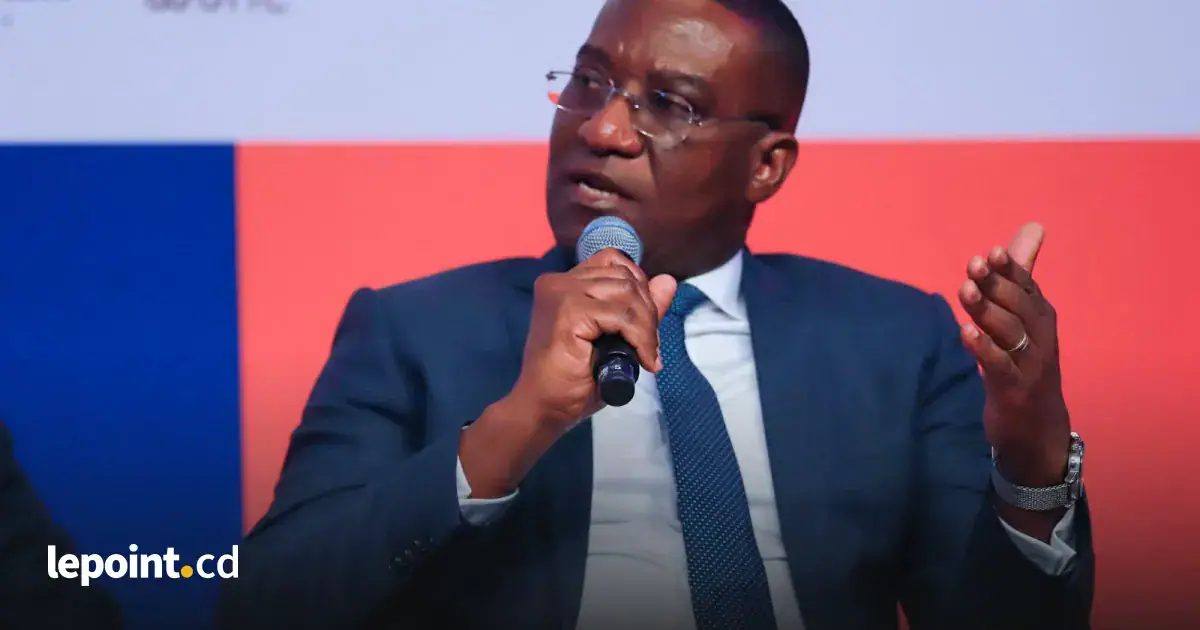
Guylain Nyembo, Minister of State for Planning and Development Coordination, recently presented the Programme de développement local des 145 territoires (PDL-145T) in Paris as a key driver of economic transformation in the Democratic Republic of Congo. The program, valued at $1.665 billion, aims to develop local infrastructure and services in 145 territories across the country. The program is being implemented by three agencies: the UN Development Programme (PNUD), the Central Coordination Office (BCeCo), and the Cellule d’exécution des financements en faveur des États fragiles (CFEF).
The program focuses on several key areas, including education, healthcare, and infrastructure development. According to the Ministry of Planning, 1,100 projects have been completed so far, including 652 schools, 370 health centers, and 78 administrative buildings. The government aims to complete this first phase before launching the second phase, which will focus on rehabilitating agricultural roads. The program is primarily funded by the Congolese state and partly by special drawing rights allocations from the International Monetary Fund (IMF).
Despite progress, the program faces challenges, including delays in implementation. The PNUD, which manages a portfolio of around $644 million in 54 territories across nine provinces, has completed 341 projects out of 764 assigned to it, representing a 44.6% completion rate. The agency cites lack of access to construction sites as a major constraint. Other agencies involved in the program also report similar challenges.
The second phase of the program will focus on rehabilitating agricultural roads, with a planned 10,000 kilometers of roads initially targeted. However, due to financial constraints, the program has been scaled down to 3,765.93 kilometers, representing 37.7% of the initial target. According to Jean-Philippe Mukuaki, coordinator of the program's technical committee, the reduction is due to financial constraints.
To address these challenges, Minister Nyembo emphasized the need to accelerate the deployment of other program components. The program's implementation committee recently examined a list of priority axes and discussed financing for the second phase and amendments to agreements with executing agencies. The government is also working to reform the legal framework for public-private partnerships to attract more investment in strategic sectors.
The program's success is crucial for the Congolese government's efforts to transform the economy and improve living standards. The government has also implemented other initiatives, such as free primary education, aimed at improving education and healthcare outcomes. According to the Ministry of Planning, the program has the potential to create new opportunities for investors, particularly in the second phase, which will focus on road rehabilitation and other infrastructure projects.
The DR Congo government is working to finalize the second phase of the program, including securing funding and completing outstanding projects. With the support of international partners, including the IMF and the UN, the government aims to complete the program and achieve its development goals. Key to this effort will be effective implementation and management of the program, as well as continued support from international partners.
Key points
- The DR Congo government's $1.665 billion development program aims to transform the country's economy through infrastructure and service development in 145 territories.