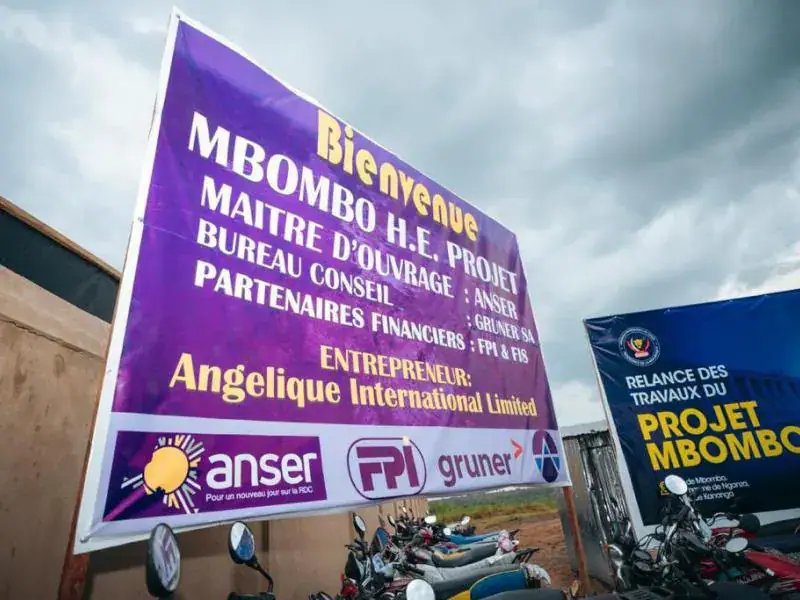
The Prime Minister of the Democratic Republic of the Congo, Judith Suminwa Tuluka, has launched the construction of the Mbombo hydroelectric power plant in Kananga, the capital of Kasaï-Central province. The ceremony took place on October 27, 2026, in the presence of government officials, national and provincial deputies, and other dignitaries. The power plant, located on the Lulua River, about 15 kilometers from Kananga, is expected to improve the electricity supply in the city and its surroundings with a projected capacity of 20 megawatts.
The project is a result of several preparatory steps, including technical, environmental, and social feasibility studies, as well as studies on access roads. The implementation of the project follows a contract between the Industrial Promotion Fund (FPI) and the National Agency for Electrification in Rural and Peri-Urban Areas (ANSER), which led to the creation of the "Hydro Mbombo SAS" company responsible for managing the future power plant. The ANSER is in charge of the project management, while the construction work has been entrusted to the Angélique International Limited company.
During the launch ceremony, Prime Minister Judith Suminwa emphasized that the realization of this project is part of the government's commitment to concretizing its promises for the development of provinces. She stated that the development of the Democratic Republic of the Congo must be visible in the daily life of every Congolese citizen. The Prime Minister also recalled that the project is not a new promise but a materialization of an important project, and that the Kasaï-Central province deserves its fair share of national investments.
The Prime Minister explained that the launch of the construction work is based on the arrangements made to ensure its financing, citing a mobilization of $120 million by the FPI and ANSER. Other partners have also planned to mobilize means to facilitate the realization of this project. Judith Suminwa also mentioned that the government is committed to concretizing the different commitments of the President of the Republic.
The Governor of Kasaï-Central, Joseph-Moïse Kambulu Nkonko, welcomed the launch of the construction work, considering it an important step for his province, which has been facing difficulties in accessing electricity for several decades. He stated that the province is reborn with the launch of this project, which is expected to bring hope to the population and improve their living conditions.
The Governor highlighted the consequences of the energy deficit on the economic and social activities of the province, particularly in the health, education, and entrepreneurship sectors. He emphasized that the insufficiency of electricity supply is an obstacle to industrialization and sustainable economic transformation in Kasaï-Central. The Governor also stressed that the valorization of the province's natural resources could contribute to creating favorable conditions for economic development and local transformation of resources.
The Mbombo hydroelectric power plant is presented as one of the responses to the energy deficit in Kananga and its surroundings. With a projected capacity of 20 MW, the power plant is expected to contribute to creating the necessary conditions for the local transformation of the province's resources, the creation of added value, and the diversification of the economy. The project is seen as a solution to the short-term difficulties of electricity supply in Kananga.
Key points
- The construction of the Mbombo hydroelectric power plant is expected to improve the electricity supply in Kananga and its surroundings with a projected capacity of 20 megawatts.
- The project is a result of a contract between the Industrial Promotion Fund (FPI) and the National Agency for Electrification in Rural and Peri-Urban Areas (ANSER).
- The launch of the construction work is based on the arrangements made to ensure its financing, citing a mobilization of $120 million by the FPI and ANSER.