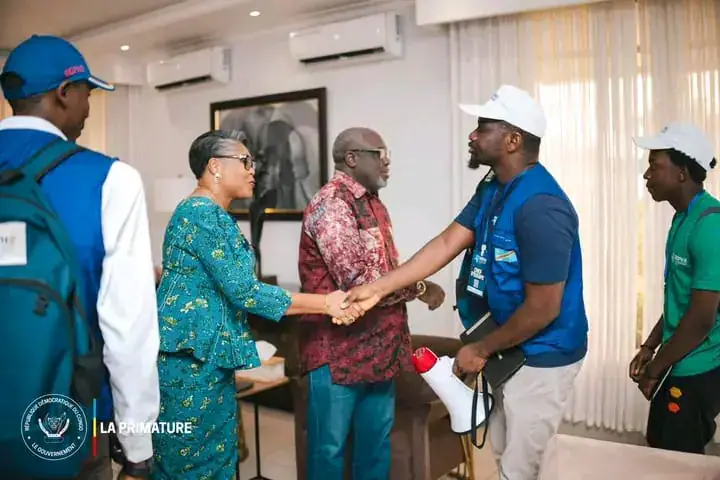
On Friday, October 30, 2026, Democratic Republic of the Congo Prime Minister Judith Suminwa Tuluka, accompanied by her husband, welcomed a team of agents responsible for mapping the second general census of population and housing (RGPH-2) at her residence. This marks her participation in the national operation and invites the entire population to follow her example. The goal of this census phase is to identify and map households across the national territory.
The census aims to provide updated and reliable demographic data to better guide public policies. It also seeks to improve infrastructure planning, including schools and hospitals, and resource allocation. Furthermore, the operation is designed to raise awareness among the population about the importance of participating in this free exercise, which does not require any payment from households.
The mapping exercise is a crucial step in preparing for the general population count scheduled for July 2027. This will be preceded by the extension of mapping operations to the remaining 25 provinces. Through this initiative, the Suminwa government reaffirms its commitment to equipping the Democratic Republic of the Congo with reliable statistics essential for effective national development planning.
Prime Minister Judith Suminwa's participation in the census is seen as a significant endorsement of the national operation. By hosting the mapping agents, she is demonstrating her support for the exercise and encouraging others to do the same. The government hopes that her example will inspire the population to participate fully in the census.
The second general census of population and housing (RGPH-2) is a critical exercise for the Democratic Republic of the Congo. It will provide the government with accurate data on the population, which is essential for planning and implementing development projects. The census will also help identify areas of need and allocate resources more effectively.
The agents responsible for mapping will work across the country to identify and record households. This exercise will help create a comprehensive database of the population, which will be used to inform policy decisions. The government has emphasized that the census is a free and voluntary exercise, and that households should not be required to make any payments.
The successful completion of the census is expected to have a positive impact on the Democratic Republic of the Congo. It will provide the government with reliable data, which will be used to improve infrastructure, healthcare, and education. The census will also help the government track progress and make informed decisions about resource allocation.
Key points
- The DR Congo government aims to use the census data to improve infrastructure planning and resource allocation.
- The census is a free and voluntary exercise that does not require any payment from households.
- The successful completion of the census is expected to have a positive impact on the Democratic Republic of the Congo's development.