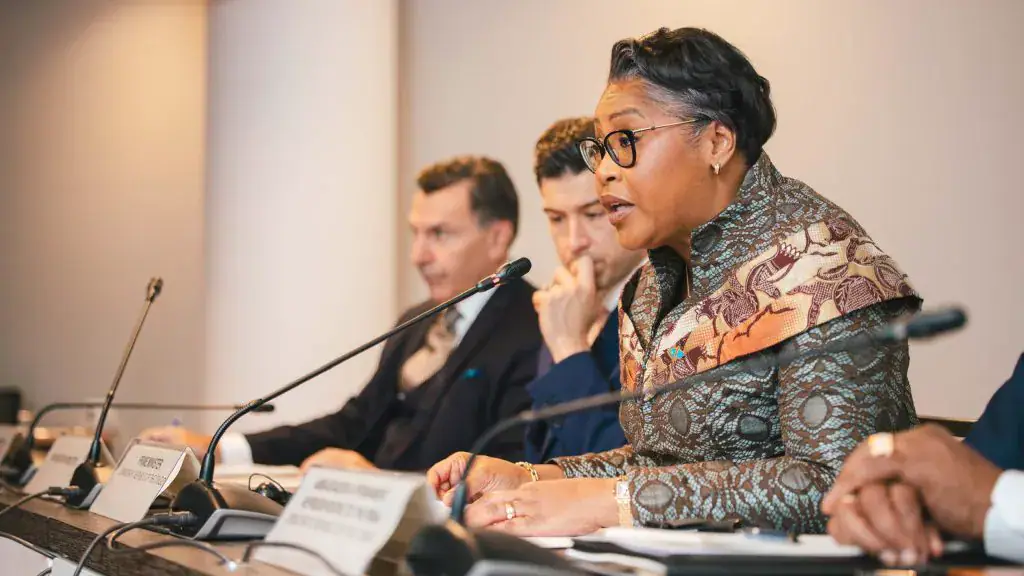
The Democratic Republic of Congo has secured $80 million in humanitarian aid from the World Bank to address the country's growing humanitarian needs. The funding was announced by Prime Minister Judith Suminwa during a meeting of the World Food Programme's (WFP) Board of Directors in Rome, Italy, on November 18, 2026. The aid will be used to facilitate the transportation of humanitarian kits, particularly in the fight against Ebola.
The funding will also provide logistical support to the WFP and UNHAS, which specializes in humanitarian air transport. For the Congolese government, this support is crucial in responding to the multiple humanitarian and health emergencies facing the country. Prime Minister Suminwa emphasized the need for urgent humanitarian assistance, particularly in the eastern provinces, where insecurity and displacement have led to a significant increase in humanitarian needs.
During her address to the WFP Board of Directors, Prime Minister Suminwa presented a concerning picture of the humanitarian situation in the DRC, highlighting the impact of the conflict in the east. She denounced the consequences of the aggression by Rwanda, including persistent insecurity, mass displacement of populations, and the loss of livelihoods for many families. The Prime Minister also emphasized the need to review the allocation of resources under the 2027-2030 Strategic Plan.
According to the figures presented by Prime Minister Suminwa, 75.3% of the funding is allocated to emergency humanitarian response, while only 3.8% is dedicated to supporting social safety nets for community recovery. The Congolese government is advocating for a rebalancing of the budget in favor of resilience and development initiatives. Prime Minister Suminwa also highlighted the government's program to provide school meals based on local purchases, launched in the first half of 2026.
In addition to the World Bank's support, the Congolese government has presented a contribution of $6.593 million mobilized by the Social Fund of the DRC, thanks to financing from the African Development Bank. This funding, made available to the WFP, targets 3,000 vulnerable households, 30 cooperatives, and six unions. The program also includes literacy actions, the participation of 1,000 women, a commercialization fund of $90,000, and the establishment of a purchasing center with a capacity of 1,000 tons.
Prime Minister Suminwa also raised two questions related to the sovereignty and governance of humanitarian assistance. She requested that the WFP share biometric data on four million Congolese eligible for humanitarian aid, in order to harmonize it with the Unique Social Register under construction at the Ministry of Social Affairs. She also advocated for a formal mechanism of strategic co-pilotage between the government and the WFP to ensure joint monitoring of interventions.
The Prime Minister's speech concluded with a call to action, urging international partners and financial institutions to provide predictable, sustainable, and innovative financing. The goal is to transform humanitarian emergencies into opportunities for autonomy, peace, and development, while reducing hunger and saving lives. The DRC's humanitarian crisis requires a sustained and coordinated response, and the government's efforts to secure funding and support are crucial in addressing the needs of affected populations.
Key points
- The DRC has secured $80 million in humanitarian aid from the World Bank to address growing humanitarian needs.
- Prime Minister Judith Suminwa emphasized the need for urgent humanitarian assistance, particularly in the eastern provinces.
- The Congolese government is advocating for a rebalancing of the budget in favor of resilience and development initiatives.