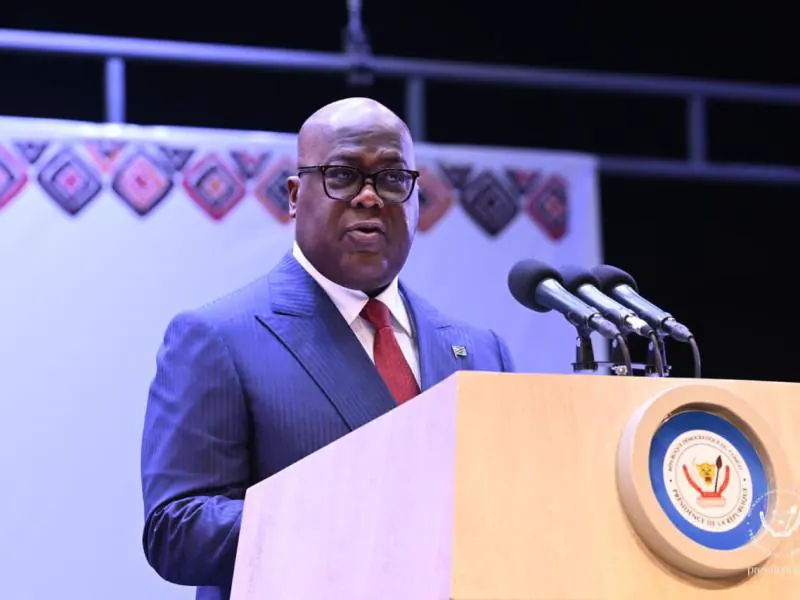
President Félix Tshisekedi of the Democratic Republic of the Congo has signed an ordinance establishing a committee to prepare for a national dialogue. This move has been met with diverse reactions from the country's sociopolitical environment. The opposition views the ordinance as a format of dialogue favorable to Tshisekedi, while his supporters see it as a step towards achieving national cohesion and peace.
Joseph Nkoy Wembo, a national deputy from the ruling majority and representative of Katako-Kombe in Sankuru, expressed his satisfaction with the ordinance. He stated that Tshisekedi is genuinely committed to the dialogue process, describing it as a significant step towards peace, national cohesion, and state refoundation. Nkoy emphasized that the ordinance demonstrates Tshisekedi's determination to achieve national cohesion and combat the balkanization of the country.
The ordinance places the committee under the direct authority of the President of the Republic, a move opposed by some who argue that the head of state is himself a party to the conflict and should not control the dialogue process. However, Nkoy disagrees with this view, questioning how the President, as an institution representing the nation, could be part of the conflict. He argued that the dialogue process should be led by the President, as the first institution in the country.
The opposition and other forces have advocated for a neutral mediation, possibly under the auspices of the Catholic Church's National Episcopal Conference of Congo (CENCO) and the Ecumenical Council of Churches (ECC). However, Nkoy rejected this idea, stating that the process should be led by state institutions. He emphasized that private structures, such as CENCO, can play a role but should not replace state institutions.
According to Nkoy, the dialogue process is inclusive and places the people at its center. The process, described as a sovereign initiative conceived and led by Congolais, will begin with consultations in the 26 provinces before the national assembly in Kinshasa. Tshisekedi has set a maximum duration of three months for the process. The President announced the establishment of an organization committee to prepare the different stages of the process.
The goal of the dialogue is to achieve a National Pact for Peace, Cohesion, and State Refoundation, accompanied by a mechanism for monitoring the commitments that will be made. The signing of the ordinance marks a new stage in the implementation of the national dialogue announced by Tshisekedi in his address to the nation on August 27.
Clément MUAMBA reported on this development, highlighting the significance of the ordinance and the reactions it has sparked. The national dialogue aims to address the country's challenges and promote peace and stability. Key points include the President's commitment to national cohesion, the opposition's concerns about neutrality, and the planned duration of the dialogue process.
Key points
- President Tshisekedi's ordinance establishes a committee for a national dialogue
- The opposition questions the President's neutrality in the dialogue process
- The dialogue aims to achieve a National Pact for Peace, Cohesion, and State Refoundation