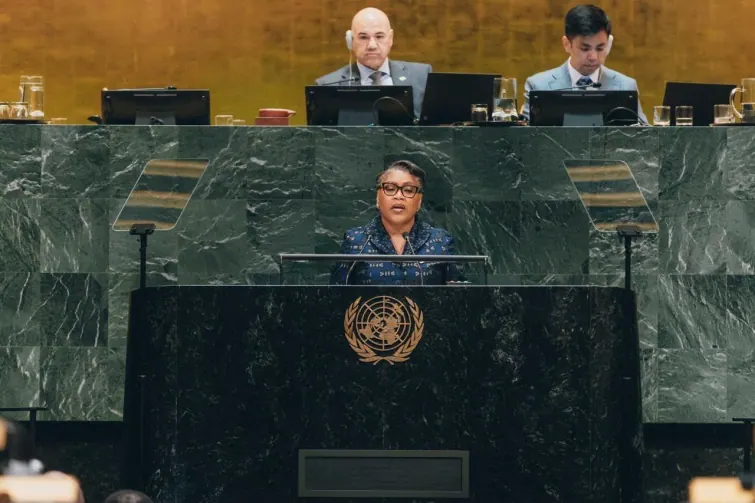
On September 24, 2026, the Democratic Republic of the Congo took a strong stance against the use of "blood minerals" in the global economy at the 81st session of the UN General Assembly in New York. Prime Minister Judith Suminwa emphasized that the country's minerals should not be used to fuel conflict and instability. She stated that the DR Congo will no longer be content with simply being a supplier of raw materials.
Suminwa outlined the DR Congo's new vision for its mining sector, which focuses on local transformation of critical minerals. The goal is to develop industrial value chains, create jobs, and strengthen the country's economic sovereignty. The DR Congo aims to move beyond being just a source of raw materials and become a key player in the global economy. This vision is driven by the need to add value to its minerals and reduce dependence on external processing.
The DR Congo's ambition is to transform its cobalt and copper on its own territory, develop battery precursors and industrial components, and integrate its companies into global value chains. Suminwa highlighted the importance of training engineers, supporting researchers, and promoting the country's industrial development. By doing so, the DR Congo hopes to become a major player in the global economy and reduce its vulnerability to external shocks.
The DR Congo's push for local transformation of its minerals is driven by the growing demand for critical minerals such as copper, cobalt, lithium, and nickel. The global transition to renewable energy, electrification of transportation, and expansion of digital infrastructure have increased the demand for these minerals. Suminwa emphasized that the governance of strategic resources should be a key issue for global peace, development, and security.
Suminwa also highlighted the need for a new approach to governance that prioritizes the exploitation of strategic resources as a means of promoting peace, development, and security. She noted that some of the resources that fuel conflicts in the DR Congo are also critical to the global economy. The DR Congo is calling for a more equitable and sustainable approach to the extraction and processing of its minerals.
The DR Congo's stance on "blood minerals" has been welcomed by many in the international community. The country's efforts to promote sustainable and responsible mining practices are seen as a key step towards reducing conflict and promoting development in the region. The DR Congo's push for local transformation of its minerals is also expected to have a positive impact on the country's economy and people.
The DR Congo's message at the UN General Assembly is clear: the country will no longer be content with simply being a supplier of raw materials. It wants to add value to its minerals, promote sustainable development, and become a key player in the global economy. The international community is expected to take note of the DR Congo's ambitions and work towards a more equitable and sustainable approach to the extraction and processing of critical minerals.
Key points
- DR Congo Prime Minister Judith Suminwa urges global community to shun 'blood minerals' at UN General Assembly
- DR Congo outlines new vision for mining sector, focusing on local transformation of critical minerals
- DR Congo aims to develop industrial value chains, create jobs, and strengthen economic sovereignty